Installing Large-Format Tile on a Terrace and Veranda: Creating an Ideal Space for Relaxation
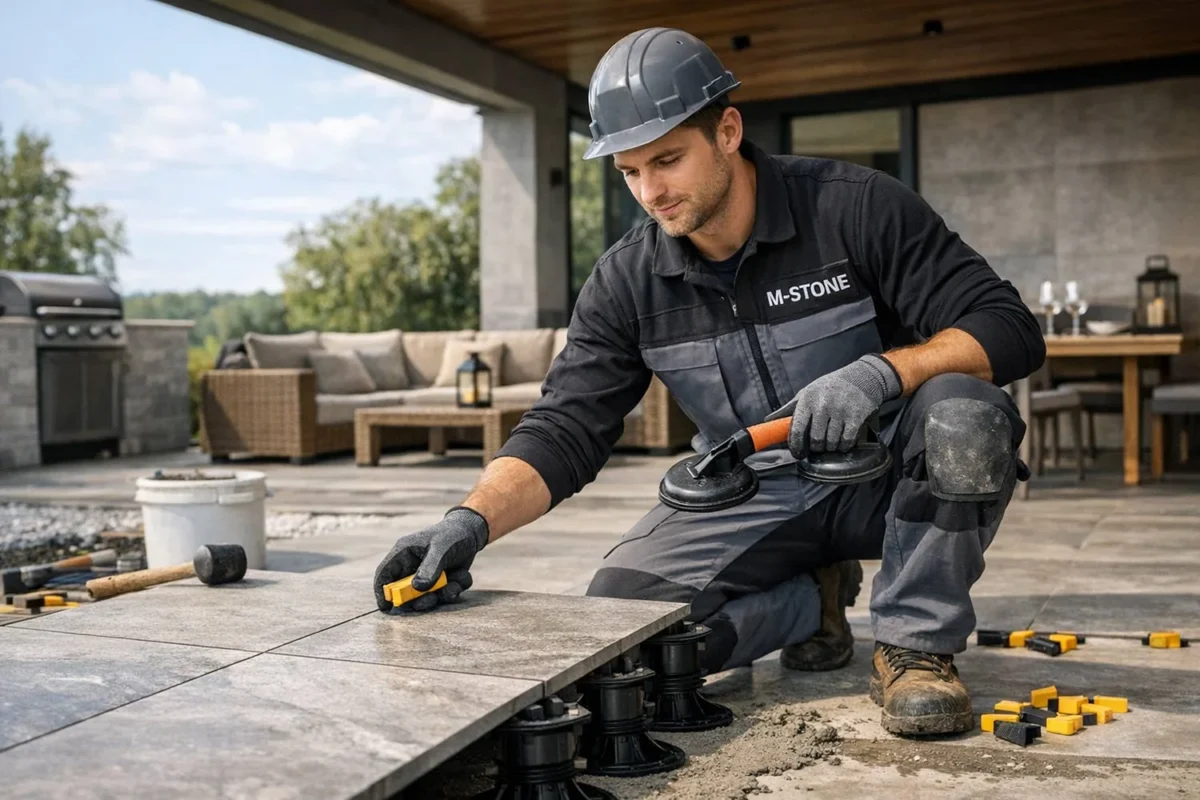
A terrace and a veranda are favourite places for relaxing in the fresh air, evenings with the family, summer breakfasts and barbecues with friends. A quality terrace floor must be not only beautiful but also withstand all kinds of weather: rain, snow, frost, heat, ultraviolet. M-STONE offers professional services for the installation of large-format tile, porcelain stoneware and natural stone (travertine, granite, marble, onyx) on terraces and verandas in Kyiv and across Ukraine. We will create a space for you that will last for decades and keep its flawless look in any weather.
Why is large-format tile the best choice for a terrace and veranda?
Advantages of porcelain stoneware and natural stone for outdoor spaces
1. Absolute frost resistance and resistance to temperature fluctuations
A terrace and a veranda are exposed to extreme temperature fluctuations: from -30°C in winter to +50°C in summer (on the sunny side dark tile can heat up even more). Porcelain stoneware for exterior work withstands more than 300 freeze-thaw cycles without deformation, cracks or delamination.
Frost resistance: facade-series porcelain stoneware (class F200, F300) and natural granite have a microporous structure that does not accumulate water inside. Even if water gets onto the surface, it does not penetrate into the body of the material, so the tile does not crack when it freezes.
Travertine and marble are also frost-resistant (over 100 cycles) but need additional treatment with water-repellent products to protect against moisture.
2. Waterproofness and resistance to precipitation
On an open terrace there is constant moisture: rain, dew, snow, ice. Porcelain stoneware has water absorption below 0.5%, meaning the material does not absorb water at all. The floor does not deform, swell, go mouldy or get covered with fungus or moss.
Natural granite has water absorption below 0.3%, the best figure among all materials. Travertine and marble are more porous (water absorption 1-3%), so they need a mandatory water-repellent treatment (Lithofin, Fila, Akemi) to protect against moisture.
3. UV resistance (it does not fade in the sun)
A terrace on the south side of a house receives a huge amount of sunlight all day. Many materials (wood, composite decking, some kinds of artificial stone) fade, lose colour and yellow after 2-3 years of use. Porcelain stoneware and natural stone are completely UV resistant: the colour stays unchanged even after decades in the open air.
4. Wear resistance and resistance to mechanical damage
A terrace holds furniture (tables, chairs, loungers), and pots with plants, grills, barbecues and flower planters get moved around. Porcelain stoneware withstands impact loads and does not get scratches from moving furniture or dents from table legs.
Hardness of porcelain stoneware and granite: 6-7 on the Mohs scale. For comparison: wood is 1-2, composite decking 2-3.
5. Anti-slip properties
On a terrace, especially after rain or morning dew, the floor can be wet. There is a danger of slipping, falling and injury. Porcelain stoneware with an anti-slip surface of class R11, R12, R13 has a rough, relief texture that allows safe movement even in wet shoes or barefoot.
Slip-resistance classes for a terrace
- R10: the minimum requirement for covered terraces.
- R11: recommended for open terraces (rain, dew).
- R12-R13: for swimming pools, areas around fountains, spa.
Natural stone (travertine, granite) with a ‘brushed’ or ‘antique’ finish has a naturally anti-slip surface.
6. Easy care and cleaning
A terrace gets dirty with leaves, dust, pollen and footprints. Porcelain stoneware and granite are easy to wash:
- Sweeping with a broom or vacuum cleaner for dry cleaning.
- Damp cleaning with a mop and cleaning product.
- For a deep clean, a pressure washer (pressurised water quickly cleans the tile of dirt, leaves and dust).
Natural stone (travertine, marble) is also easy to clean but needs special (non-acidic) cleaning products.
7. Aesthetics and a wide choice of design
Modern porcelain stoneware for terraces imitates any natural material: wood, stone, travertine, slate, sandstone. You can create:
- A Mediterranean style: travertine in beige and cream shades.
- An eco style: wood-look porcelain stoneware (oak, teak, larch).
- Modern minimalism: concrete-look porcelain stoneware, grey granite.
- A classic style: natural marble, granite.
Tile formats for terraces: 30×60 cm, 40×80 cm, 60×60 cm, 60×120 cm. Large formats create the effect of a monolithic surface, with a minimum of joints, beautiful and practical.
8. Durability (50-100 years)
Porcelain stoneware and natural stone are among the most durable materials. A terrace with such a surface lasts 50-100 years without replacement. Wood (even hardwood) lasts 10-15 years, composite decking 15-20 years, while porcelain stoneware and granite are practically eternal.
9. Resistance to biological damage
Wood on a terrace is prone to rot, fungus, moss and insect pests (bark beetle, woodworm). Even when treated with antiseptics, signs of destruction appear after 5-7 years. Porcelain stoneware and stone are completely resistant to biological damage: they do not rot, go mouldy or get covered with moss (provided they are installed correctly with a slope for water drainage).
10. Fire safety
A terrace is a place where a grill, barbecue or fireplace is often lit. Porcelain stoneware and natural stone are non-combustible materials of class NG. They do not ignite or release toxic gases when heated, and sources of open fire can be placed safely.
11. Eco-friendliness
Porcelain stoneware is made from natural clay and quartz sand, which are environmentally clean components. Travertine, marble and granite are natural rocks millions of years old. Such materials are completely safe for the health of people and pets and for the environment.
Types of terraces and verandas: features of cladding
1. An open terrace (without a roof)
An open terrace is exposed to every kind of weather: rain, snow, hail, wind, direct sunlight, frost. Only frost-resistant facade-series porcelain stoneware (class F200-F300) or natural granite suits such a terrace.
Requirements for the tile
- Frost resistance: at least 200 cycles.
- Anti-slip surface: R11, R12.
- Water absorption: below 0.5%.
Installation: a mandatory floor slope of 1-2% for water drainage, waterproofing of the base, and frost-resistant adhesive and grout.
2. A covered terrace (under a roof, without walls)
The terrace is protected from direct precipitation by a roof but open at the sides. The wind can blow rain and snow in. The winter temperature is close to that outdoors. Frost-resistant porcelain stoneware or natural stone suits it.
Requirements for the tile
- Frost resistance: at least 150 cycles.
- Anti-slip surface: R10, R11.
3. A closed veranda (under a roof, with walls, glazed)
The veranda is protected from precipitation and wind but is not heated. In winter the temperature may fall below zero. Frost-resistant porcelain stoneware or natural stone suits it.
A recommendation: install underfloor heating (an electric cable or mat) so the veranda can be used in winter.
4. An insulated and heated veranda (joined to the living space)
The veranda is fully integrated into the house, heated, with a temperature of +20…+24°C all year round. It is a full room. Any porcelain stoneware or natural stone to your taste suits it.
Which kinds of large-format tile suit terraces and verandas?
1. Frost-resistant porcelain stoneware imitating natural stone
Advantages
- Maximum frost resistance (200-300 cycles).
- An anti-slip rough surface.
- The aesthetics of natural stone (granite, slate, sandstone, travertine).
- Dirt and leaves are less noticeable on a mottled texture.
Popular collections
- Cerrad Apenino Rosso 60×60 cm, imitating red granite.
- Paradyz Scandiano Rustico 30×60 cm, imitating slate, with an aged surface.
- Tubadzin Terraform Graphite 119.8×59.8 cm, imitating graphite basalt.
Which terraces it suits: open, covered, unheated verandas.
2. Wood-look porcelain stoneware
Advantages
- The aesthetics of natural parquet and decking without their drawbacks.
- A warm, cozy atmosphere.
- Resistance to moisture, frost, sun and fungus.
- It does not crack, deform or rot.
Popular collections
- Atlas Concorde Axi Golden Oak 20×120 cm, imitating oak boards.
- Cerrad Mattina Bianco 120×20 cm, imitating bleached pine boards.
- Paradyz Maloe Brown 20×120 cm, imitating dark teak.
Which terraces it suits: covered terraces, insulated heated verandas.
Laying pattern: parallel to the house (horizontal ‘boards’) or ‘herringbone’ for elegance.
3. Natural travertine
Advantages
- Real natural stone millions of years old.
- Warm beige, cream, walnut and brown shades.
- A natural texture with pores and inclusions; every slab is unique.
- Frost resistance (with a water-repellent treatment).
- It does not heat up in the sun as much as dark granite (you can walk barefoot).
Formats: slabs of 40×60 cm, 60×60 cm, 60×120 cm. Thickness: 20-30 mm (thicker tile for exterior work).
Surface finish
- Brushed: light roughness, anti-slip, R11.
- Tumbled: artificially aged, very relief, R12.
- Honed: matt smooth (for covered terraces, R9-R10).
Countries of origin: Turkey (Classic, Noce, Silver, Walnut), Italy (premium Travertino Romano varieties).
Which terraces it suits: open and covered terraces, verandas. A water-repellent treatment once every 1-2 years is mandatory.
Care: use only cleaning products with a neutral pH (non-acidic).
4. Natural granite
Advantages
- The strongest natural stone (hardness 7 on the Mohs scale).
- Absolute frost resistance (300+ cycles).
- Waterproofness (water absorption < 0.3%).
- Resistance to ultraviolet and chemicals.
- It serves for centuries (historic granite pavements last 200-300 years).
Popular kinds of granite for terraces
- Pokostivskyi granite (Ukraine): grey-pink, red.
- Baltic Brown (Finland): brown with black inclusions.
- Leopard Skin (India): mottled beige-brown.
- Rosa Porrino (Spain): pink with white and black inclusions.
Formats: slabs of 30×30 cm, 40×40 cm, 60×60 cm. Thickness: 20-30 mm.
Surface finish
- Flamed: rough, anti-slip, R12-R13, ideal for open terraces.
- Brushed: light roughness, R11.
- Polished: glossy (only for covered terraces, because it is very slippery).
Which terraces it suits: any type (open, covered, insulated). A premium option.
5. Natural marble
Advantages
- A luxurious, elegant look.
- A unique pattern of veining.
- A large palette of colours: white, beige, grey, green, black.
Limitations: marble is softer than granite (hardness 3-4), so it wears away faster. For terraces it is recommended only for covered ones, protected from direct precipitation and heavy use.
Popular kinds of marble for terraces
- Crema Marfil (Spain): cream, warm.
- Grey Bardiglio (Italy): grey with white veining.
- Emperador Dark (Spain): dark brown.
Formats: slabs of 60×60 cm, 60×120 cm.
Which terraces it suits: covered verandas, winter gardens, conservatories. A water-repellent treatment is mandatory.
Care: do not use acidic products (vinegar, citric acid), only special ones for marble.
6. Clinker tile
Advantages
- High wear resistance (PEI V).
- An anti-slip rough surface (R12-R13).
- Resistance to frost (300+ cycles), water and chemicals.
- The aesthetics of brick paving.
- A large range of colours: from light beige to dark brown.
Popular manufacturers
- Roben (Poland): clinker for terraces, stairs, paths.
- Feldhaus Klinker (Germany): premium hand-moulded clinker.
- ABC Klinkergruppe (Germany): a wide choice of colours and formats.
Formats: 20×10 cm, 24×11.5 cm (brick imitation), 30×30 cm, 30×60 cm.
Which terraces it suits: open and covered terraces in a classic, European style.
The process of installing large-format tile on a terrace: stages of work from M-STONE
Stage 1: consultation and survey of the terrace
What we do
📏 We measure the area of the terrace/veranda and take the shape into account (rectangular, L-shaped, polygonal, curved).
🏗️ We assess the condition of the base: a concrete slab, wooden decking, old tile, soil.
🌡️ We determine the type of terrace:
- Open (without a roof).
- Covered (under a roof).
- A closed veranda (glazed).
- A heated veranda.
🌞 We take the orientation of the terrace into account:
- South side: strong heating in the sun, light tile (travertine, light granite) is better.
- North side: shade, humidity, anti-slip R11-R12 tile is better.
🎨 We show tile samples: porcelain stoneware, travertine, granite, marble, clinker.
💡 We discuss the need for:
- Waterproofing (mandatory for open terraces).
- A drainage system (removing rainwater).
- Floor insulation (for heated verandas).
- Underfloor heating (an electric cable for comfort).
📋 We draw up an estimate with a detailed calculation of work and materials.
Stage 2: preparing the base for the tile
Removing the old covering (if needed)
- We remove old wooden decking, tile and the concrete screed (if damaged).
- We clean the base of dirt, vegetation and roots.
Preparing the concrete base (if the terrace is on a concrete slab)
- Checking the strength of the concrete: tapping, a pull-off test. We remove weak areas and fill them with repair mixes.
- Creating a slope for water drainage is mandatory for open and covered terraces!
- Slope: 1-2% (1-2 cm per metre) from the house to the edge of the terrace.
- Water must flow away from the house so it does not seep under the foundation.
- The slope is created at the concrete screed stage or adjusted by the thickness of the adhesive.
- Waterproofing the concrete base is mandatory for open terraces!
- Coating waterproofing (Ceresit CR 65, Mapei Mapelastic): 2-3 layers with a brush.
- Roll waterproofing (bikrost, hydroizol): stuck onto bitumen mastic with a 10-15 cm overlap onto the house walls.
- This protects the concrete slab from moisture penetration and prevents the concrete from breaking up when water freezes.
- Installing drainage (if necessary):
- If the terrace is large (20+ sq. m), we install drain gullies or linear drainage channels to remove rainwater.
- The gullies are connected to the sewer or drainage system.
Preparing the base on the ground (if the terrace is built from scratch)
- Excavating the soil to a depth of 30-40 cm.
- Forming a sand-and-gravel bed:
- A 10 cm layer of sand, thoroughly compacted.
- A 10 cm layer of crushed stone, compacted.
- This is a drainage bed that carries off ground moisture.
- A reinforced concrete slab:
- Thickness 10-15 cm.
- Reinforcement: a metal mesh of 100×100 mm, wire diameter 5-6 mm.
- A mandatory slope of 1-2% away from the house.
- Waterproofing the concrete slab (after it has dried, after 28 days).
Priming the base
- We apply a deep-penetration primer (Ceresit CT 17) to strengthen the concrete and improve the adhesion of the adhesive.
Preparation time: 7-14 days depending on the scope of work and the drying of the concrete.
Stage 3: choosing the adhesive mix and grout
Adhesive for terraces
For exterior work we use frost-resistant flexible adhesive of class C2 S1 or C2 S2.
Recommended brands:
- Ceresit CM 17 (frost-resistant, flexible, universal).
- Ceresit CM 117 (reinforced, for large formats).
- Knauf Flex (flexible, frost-resistant).
- Mapei Keraflex Maxi S1 (for heavy loads).
- Sopro FKM Trass (special for natural stone).
Grout for the joints
For terraces the best choice is epoxy grout (Litokol Starlike, Mapei Kerapoxy):
- Completely waterproof.
- Frost-resistant (300+ cycles).
- Flexible (it compensates for thermal expansion).
- It does not absorb dirt, moss or algae.
- It does not yellow or darken.
An alternative is frost-resistant cement grout (Ceresit CE 40, Mapei Ultracolor Plus).
Grout colour for a terrace
- Dark (graphite, brown, black): dirt, leaves and moss are less noticeable on it.
- Grey: a universal option.
- Matching the tile: for a monolithic look.
Joint width: 5-8 mm for exterior work (wider joints than indoors, to compensate for thermal expansion).
Stage 4: laying the large-format tile on the terrace
The tile layout
For a terrace it is important to lay the tile out correctly:
- Avoid small trimmed pieces at the house walls, railings and stairs.
- Make the laying symmetrical (for large terraces).
- Allow for the slope for water drainage.
Methods of laying
1. A straight row (parallel to the house)
- The most popular way.
- A minimum of waste.
- Suitable for rectangular terraces.
2. Diagonal laying
- Visually enlarges the space.
- More waste (10-15%).
- Looks elegant.
3. ‘Roman paving’ (rustic)
- Different tile formats (30×30, 30×60, 60×60) are laid at random.
- Creates the effect of ancient cobblestones.
- Suits a classic, Mediterranean style.
Applying the adhesive
The ‘pull-off’ method: we apply the adhesive:
- To the base with a 10-12 mm notched trowel (for 60×60 cm tile).
- To the tile in a thin layer.
This ensures 100% coverage and no voids.
Laying tile allowing for the slope
- Laying begins at the house (the higher point).
- Moving toward the edge of the terrace (the lower point).
- Checking the slope with a laser level on every row of tile.
- Adjusting the adhesive thickness to create the required slope.
Fitting a TLS (levelling system)
For even joints of 5-8 mm we use wedges and clamps (Rubi, DLS, 3D Krest).
Controlling level and slope
We constantly check:
- The level of every tile (a straightedge, a spirit level).
- The slope away from the house (a laser level).
- The absence of voids (tapping with a rubber mallet).
Expansion joints
For large terraces (over 30 sq. m) we make expansion joints every 5-6 metres:
- Joints 8-10 mm wide.
- Located around the perimeter of the terrace (the junction with the house walls) and through the middle (if the terrace is very large).
- They compensate for thermal expansion of the materials.
- They are filled with flexible sealant (not grout!).
A technological break
Do not walk on freshly laid tile for at least 3-5 days (full drying of the adhesive).
Stage 5: grouting and final finishing
Grouting (5-7 days after laying)
- We remove the levelling clips and clean the adhesive out of the joints.
- We dampen the joints with water (for cement grout).
- We apply the grout with a rubber float in diagonal movements.
- We level the joints with a grouting trowel.
- After 20-30 minutes we wash off the grout residues with a damp sponge.
- Polishing the tile.
Sealing the expansion joints
We fill them with flexible polyurethane sealant (Sikaflex, Soudal, Ceresit), which compensates for movement of the base without tearing.
Protecting natural stone
We treat travertine, marble and granite with a water-repellent product (Lithofin, Fila, Akemi):
- It protects against moisture, stains, moss and algae.
- It emphasises the natural colour of the stone.
- It extends the service life.
- Applied with a brush or roller in 2 coats.
Fitting skirting (if necessary)
If the terrace adjoins the house wall, we fit skirting made of the same tile or stone for a neat transition.
Stage 6: installing stairs to the terrace (if needed)
If the terrace is raised above ground level, stairs are needed:
- Cladding the stairs with the same tile as the terrace (for a single style).
- Anti-slip overlays on the steps (R12-R13).
- Lighting the stairs with an LED strip for safety in the dark.
Design solutions for terraces and verandas
Styles of terrace cladding
1. A Mediterranean style
- Travertine in beige, cream and terracotta shades.
- Natural stone mosaic for accent zones.
- Combined with white plaster, wood and terracotta pots.
2. Scandinavian minimalism
- Light wood-look or concrete-look porcelain stoneware.
- Light grey granite.
- Soft furniture with light-coloured textiles, plants in simple pots.
3. Loft, industrial style
- Concrete-look and rusty-metal-look porcelain stoneware.
- Grey granite with a rough texture.
- Combined with metal furniture and exposed brick walls.
4. A classic European style
- Clinker or natural marble.
- Geometric patterns, borders.
- Columns, wrought-iron railings, garden sculpture.
5. A Japanese zen garden
- Dark granite or slate.
- Combined with pebbles, wooden bridges, bamboo.
- Minimalism, asymmetry, naturalness.
Zoning a terrace with tile
The dining area
- Wood-look tile or travertine for coziness.
- The position of the table, chairs and barbecue.
A relaxation area (lounge)
- Soft-toned tile (travertine, light granite).
- Sofas, armchairs, poufs, small tables.
A pool/jacuzzi area
- Anti-slip R12-R13 tile.
- Drain gullies around the pool.
A green area
- Large planters with plants on the tile.
- Vertical greenery (wall planters).
Why choose M-STONE for cladding terraces and verandas?
Our advantages
✅ 10+ years of experience installing tile on terraces, verandas and summer decks.
✅ A professional team: craftsmen with a portfolio of completed terraces.
✅ A comprehensive approach: base preparation, waterproofing, drainage, tile installation, stairs.
✅ Modern equipment: laser levels, levelling systems, professional tile cutters for stone.
✅ Transparent pricing: a detailed estimate.
✅ Work in Kyiv and the region: Pechersk, Holosiivskyi, Obolon, Vyshneve, Boyarka, Irpin, Bucha, Kozyn, Koncha-Zaspa.
Portfolio: terraces we have created
A private house terrace, Kozyn
- Area: 35 sq. m
- Material: Classic Light travertine 60×60 cm, antiqued finish
- Stairs: travertine with anti-slip overlays
- Waterproofing, a slope of 1.5%
- Duration: 12 working days
A cottage veranda, Koncha-Zaspa
- Area: 50 sq. m
- Material: wood-look porcelain stoneware Atlas Concorde Axi 20×120 cm
- Underfloor heating, a glazed veranda
- Duration: 10 working days
An open terrace, Vyshneve
- Area: 25 sq. m
- Material: Leopard Skin granite 60×60 cm, heat-treated
- A drain gully, a slope of 2%
- Duration: 8 working days
View photos
- Instagram: https://www.instagram.com/mstone_kiev/
- Facebook: https://www.facebook.com/mstone.kyiv/
- YouTube: https://www.youtube.com/@M-Stone_Kyiv/
How to order tile installation on a terrace?
M-STONE contacts
📞 +38 068 100 27 96📞 +38 050 914 18 99✉️ [email protected]
🌐 Website: https://mstone.ua/
📱 Social networks:
- Instagram: https://www.instagram.com/mstone_kiev/
- Facebook: https://www.facebook.com/mstone.kyiv/
- YouTube: https://www.youtube.com/@M-Stone_Kyiv/
Stages of cooperation
- A call: agreeing the time of the visit.
- An estimate: a detailed calculation.
- A contract: signed with guarantees.
- Purchasing materials: we help with the choice.
- Installation: carrying out the work.
- Handing over the site: acceptance, a guarantee certificate.
Advice from M-STONE experts
How to choose tile for a terrace?
Frost resistance: at least 150 cycles for covered terraces, 200+ for open ones.
Slip resistance: R11-R12 (a rough surface).
Thickness: 10-12 mm for porcelain stoneware, 20-30 mm for stone.
Colour: light colours do not heat up as much in the sun, dark ones show less dirt.
Is waterproofing needed?
Yes, absolutely for open and covered terraces (protecting the concrete base from moisture).
Is a floor slope needed?
Yes, absolutely! A slope of 1-2% away from the house ensures rainwater runs off and prevents standing water and ice.
Which grout is better?
Epoxy is the best choice (waterproof, frost-resistant). The alternative is frost-resistant cement grout.
How to care for tile on a terrace?
Regularly: sweeping up leaves and removing dirt.
Spring cleaning: a pressure washer.
For natural stone: a water-repellent treatment once every 1-2 years.
Frequently asked questions
1. How long does cladding a 30 sq. m terrace take?
With full preparation (waterproofing, slope): 10-14 working days.
2. Can tile be laid on a terrace in winter?
No, only at temperatures above +5°C (a requirement of frost-resistant adhesive).
3. Will the tile withstand frosts of -30°C?
Yes, frost-resistant porcelain stoneware and granite withstand down to -50°C.
4. Which is better: porcelain stoneware or natural stone?
Porcelain stoneware is cheaper and more frost-resistant. Natural stone is more prestigious and unique.
A terrace with large-format tile is a space for living in the fresh air
✔️ Frost resistance: withstands -50°C✔️ Waterproofness: not afraid of rain or snow✔️ Durability: 50-100 years✔️ Aesthetics: a luxurious look✔️ Anti-slip: safe in any weather✔️ Easy care: minimal effort
Create the terrace of your dreams with M-STONE!
📞 +38 068 100 27 96 | +38 050 914 18 99✉️ [email protected]🌐 https://mstone.ua/
M-STONE: experts in cladding terraces and verandas. Kyiv and Kyiv region.
The current cost of work for your project can be calculated in the online calculators or confirmed by the manager: it depends on the material, the slab format and the condition of the substrate. The consultation is free.

About M-STONE
This material was prepared by the M-STONE team: 20 years of brand history, installation of large-format tile and natural stone in Kyiv and across Ukraine. The company is led by Oleg Dolynskyi. The recommendations describe the typical order of work; a specialist refines the solution for your project after a consultation.
Contact us
We will price your project
Send the dimensions and slab format: we will calculate the material and installation and suggest the timing.