Installing Large-Format Tile in a Garage: A Strong, Practical Floor for Decades
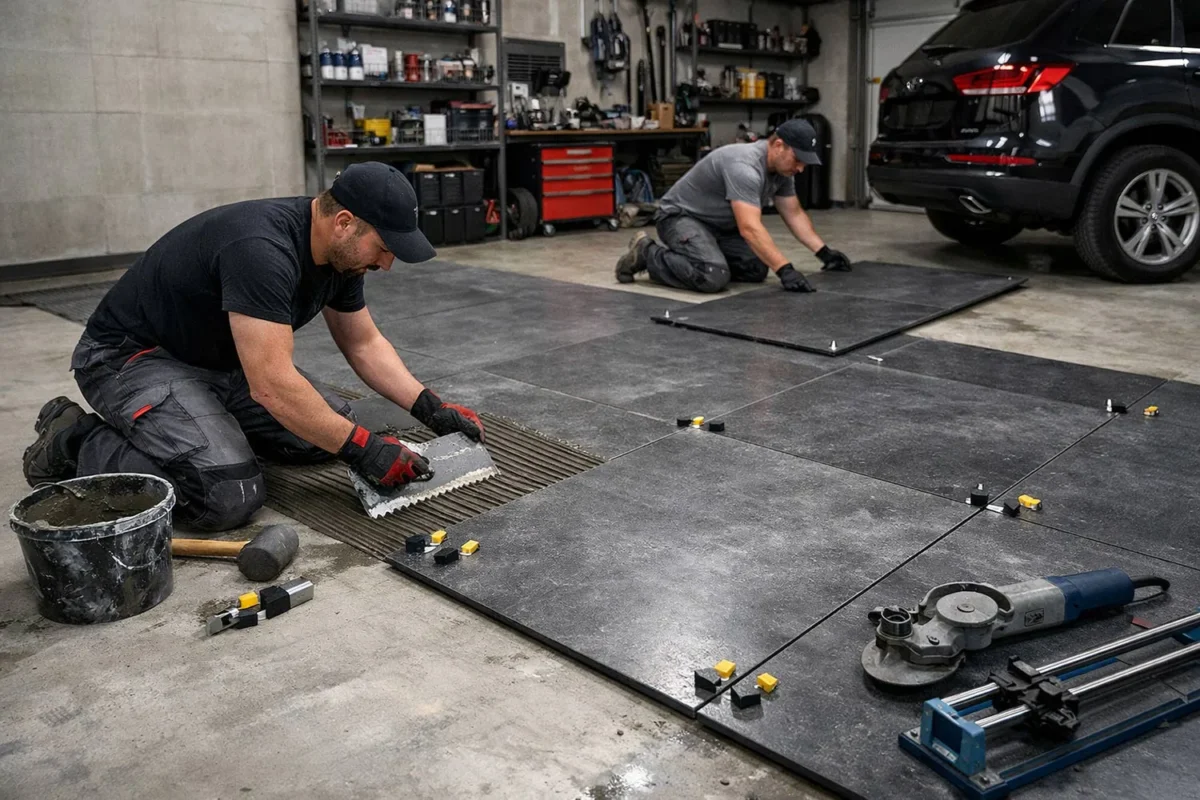
A garage is not just a place to park a car. For many owners of private houses, cottages and townhouses it is also a workshop, a tool store, a car wash and a place to store seasonal things. A garage floor is subjected to extreme loads: the weight of a car (1.5-3 tonnes), mechanical impacts from tools, chemicals (lubricants, petrol, antifreeze), temperature changes and moisture. M-STONE offers professional services for the installation of large-format tile, porcelain stoneware and natural stone (granite) in garages in Kyiv and across Ukraine. We will create a floor for you that withstands any load and lasts 50+ years without repair.
Why is large-format tile the best choice for a garage?
Advantages of porcelain stoneware and granite for garage spaces
1. Extreme strength and wear resistance (PEI V)
A garage is the zone with the highest mechanical load in the whole house. The floor must withstand:
- Static load: the weight of a car (a passenger car 1.5-2 tonnes, an SUV 2.5-3 tonnes, a minibus 3-4 tonnes).
- Dynamic load: driving in and out, braking, turning.
- Point load: the weight of the car is spread over 4 wheels, and the pressure on each wheel can reach 500-800 kg.
- Impact loads: falling tools (spanners, jacks, batteries).
Porcelain stoneware of wear-resistance class PEI V (for public spaces with a high load) is ideal for a garage. The hardness of porcelain stoneware is 6-7 on the Mohs scale (like granite). This means the material is practically invulnerable to scratches, chips and dents.
For comparison:
- A concrete floor wears away, creates dust and gets cracks after 5-10 years.
- An epoxy coating (polymer self-levelling floors) is expensive and may peel from the base.
- Rubber coverings quickly wear away from car wheels.
- Porcelain stoneware lasts 50+ years without losing its properties.
2. Waterproofness and resistance to chemicals
Moisture and chemicals are constantly present in a garage:
- Melted snow, rainwater: brought in on the wheels and underside of the car.
- Lubricants, engine oil: during servicing and repair.
- Petrol, diesel, antifreeze: leaks and spills are possible.
- Cleaning products, car chemicals: when washing the car.
Porcelain stoneware has water absorption below 0.5%, meaning the material is completely waterproof. The surface does not absorb water, lubricants, petrol or chemicals. Any stains are easily washed off with water or cleaning products.
Chemical resistance: class AA porcelain stoneware (the highest resistance) is not destroyed by contact with acids, alkalis, solvents or lubricants. This is an ideal property for a garage.
3. Frost resistance and resistance to temperature fluctuations
In an unheated garage the winter temperature can fall to -20°C and below, and in summer on the sunny side the floor heats up to +30…+40°C. Porcelain stoneware withstands temperature fluctuations from -50°C to +50°C without deformation, cracks or delamination.
Frost resistance: over 150-300 freeze-thaw cycles (for facade series). This ensures durability even in an unheated garage.
4. Anti-slip properties
In a garage the floor is often wet or soiled with oil. There is a danger of slipping, falling and injury. Porcelain stoneware with an anti-slip surface of class R11, R12, R13 has a rough, relief texture that allows safe movement even in wet shoes or with oil on the soles.
Slip-resistance classes
- R9: for dry rooms (not suitable for a garage).
- R10: for wet rooms (the minimum requirement for a garage).
- R11: for rooms with grease and oil (recommended for a garage).
- R12-R13: for industrial spaces with extreme conditions (ideal for a workshop garage).
5. Easy care and cleaning
A garage means constant dirt: sand from roads, salt, lubricants, dust from tyres. Porcelain stoneware is easy to wash:
- Sweeping with a broom or vacuum cleaner.
- Damp cleaning with a mop and cleaning product.
- For heavy contamination (lubricants, petrol), use solvents or aggressive cleaning products (porcelain stoneware is not afraid of chemicals).
- It can be washed with pressurised water (a pressure washer) for quick cleaning.
No dust: unlike a concrete floor, which constantly creates dust (cement dust is very harmful to the lungs), porcelain stoneware produces no dust. This matters for your health, especially if you spend a lot of time in the garage.
6. Aesthetics and a presentable look
A modern garage is not just a technical room but part of the house, which can look stylish and tidy. Porcelain stoneware lets you create:
- An industrial style: concrete-look, metal-look, rusty-metal-look porcelain stoneware.
- A classic style: granite-look, basalt-look, slate-look porcelain stoneware.
- A chessboard: alternating dark and light tile for visual zoning.
Tile formats for a garage: from 30×30 cm to 60×60 cm, 40×80 cm, 60×120 cm. Large formats reduce the number of joints, but different sizes can be used for zoning.
7. Durability (50+ years)
Porcelain stoneware and natural granite are among the most durable materials. The floor will last 50-100 years without replacement. A concrete floor needs repair every year (filling cracks, grinding), an epoxy coating lasts 10-15 years, and porcelain stoneware is practically eternal.
8. Fire safety
A garage is a place of increased fire hazard (storage of fuel, batteries, paints, solvents). Porcelain stoneware is a non-combustible material of class NG. It does not ignite, does not release toxic gases when heated and does not support combustion.
9. Eco-friendliness and safety for health
Porcelain stoneware is made from natural clay and quartz sand, which are environmentally clean components. It does not release harmful substances (formaldehydes, phenols). Unlike concrete, which constantly creates dust, porcelain stoneware is completely safe for the respiratory system.
Disadvantages of tile in a garage and how to minimise them
Disadvantage 1: ‘More expensive than a concrete floor’
The answer: at first glance, yes. But if you take into account the cost of ownership over 20-30 years:
- A concrete floor: needs yearly repair (filling cracks, topping, epoxy coatings), and major repair every 5-10 years.
- Porcelain stoneware: a one-off investment, 50+ years with no maintenance costs.
In the long run tile is cheaper.
Disadvantage 2: ‘Complicated installation’
The answer: yes, installing tile takes professional skills and special tools. But M-STONE has more than 10 years of experience cladding garages; we know all the nuances and stand behind the quality.
Disadvantage 3: ‘Tile may crack under the weight of a car’
The answer: cracks are possible only in the case of:
- A poor-quality base (an unstable screed, voids under the tile).
- Incorrect installation (a thin layer of adhesive, voids).
With correct installation (a strong screed, adhesive applied by the ‘pull-off’ method, no voids) porcelain stoneware withstands a load of 500+ kg/cm², many times more than the weight of a car.
Which kinds of large-format tile suit a garage?
1. Technical porcelain stoneware (unglazed, monocolour)
Advantages
- Maximum wear resistance (PEI V).
- A uniform structure (the colour runs through the full thickness of the tile).
- Even if the surface wears, the colour does not change.
- The cheapest kind of porcelain stoneware.
Popular manufacturers of technical porcelain stoneware
- Cersanit (Ukraine): the Technogres series.
- Estima (Russia): the Standard series.
- Keramin (Belarus): technical porcelain stoneware.
Formats: 30×30 cm, 40×40 cm, 60×60 cm.
Colours: grey, dark grey, brown, red.
Which garages it suits: unheated, technical garages, car parks, car service centres, warehouses.
2. Porcelain stoneware imitating natural stone (granite, basalt, slate)
Advantages
- High wear resistance (PEI IV-V).
- The aesthetics of natural stone.
- An anti-slip rough surface (R11, R12).
- Dirt and tyre marks are less noticeable on a mottled texture.
Popular collections
- Cerrad Apenino Antracyt 60×60 cm, imitating dark basalt.
- Paradyz Taranto Grafit 59.8×59.8 cm, imitating graphite granite.
- Tubadzin Terraform Graphite 119.8×59.8 cm, imitating slate.
Which garages it suits: insulated, heated garages, workshop garages, showcase garages for collector cars.
3. Concrete-look porcelain stoneware
Advantages
- A modern industrial look.
- A matt anti-slip surface.
- Practical: dirt is less noticeable on a grey background.
- Easily combined with other materials (metal, glass).
Popular collections
- Imola Micron 2.0 M260 Grey 60×60 cm, large-format concrete.
- Pamesa Essen Grafito 60×120 cm, graphite concrete.
- Rocersa Habitat Grey 59.5×59.5 cm, light-grey concrete.
Which garages it suits: modern garages in loft, minimalist and hi-tech styles.
4. Natural granite
Advantages
- The strongest natural stone (hardness 7 on the Mohs scale).
- Absolute frost resistance (300+ cycles).
- Waterproofness (water absorption < 0.3%).
- Resistance to chemicals.
- It lasts 100+ years.
Popular kinds of granite for garages
- Pokostivskyi granite (Ukraine): red-grey, strong.
- Absolute Black (India): black glossy or matt.
- Leopard Skin (India): mottled, dirt does not show on it.
Formats: slabs of 30×30 cm, 40×40 cm, 60×60 cm. Thickness: 15-20 mm (thicker than porcelain stoneware, it withstands greater load).
Which garages it suits: premium garages, garages for collector cars, showroom garages, open car parks.
5. Clinker tile
Advantages
- High wear resistance (PEI V).
- An anti-slip rough surface (R12-R13).
- Resistance to frost, water and chemicals.
- The aesthetics of brick paving.
Popular manufacturers
- Roben (Poland): clinker for garages and car parks.
- Feldhaus Klinker (Germany): premium clinker.
- ABC Klinkergruppe (Germany): a wide choice of colours.
Formats: 20×10 cm, 24×11.5 cm (brick imitation), 30×30 cm.
Which garages it suits: garages in a classic style, private-house garages in a European style.
The process of installing large-format tile in a garage: stages of work from M-STONE
Stage 1: consultation and survey of the garage
What we do
📏 We measure the area of the garage and take the shape into account (rectangular, square, L-shaped).
🏗️ We assess the condition of the base: a concrete slab, an old screed, pits, cracks.
🚗 We clarify the purpose of the garage:
- Parking for a passenger car.
- A garage for an SUV/minibus.
- A workshop garage (repair, servicing).
- A storage garage (storing tools and belongings).
🌡️ We determine the type of garage:
- An open canopy (frost-resistant porcelain stoneware is needed).
- A closed unheated garage (frost-resistant porcelain stoneware).
- An insulated heated garage (any porcelain stoneware).
🎨 We show tile samples: technical porcelain stoneware, stone-look/concrete-look porcelain stoneware, granite.
💡 We discuss the need for:
- Waterproofing (if the garage is at ground level and there is a risk of flooding).
- Floor heating (for heated garages).
- Drain gullies (for garages with a car wash).
📋 We draw up an estimate with a detailed calculation of work and materials.
Stage 2: preparing the base for the tile
A quality base is 80% of the success of installation. For a garage this is critically important because of the high loads.
Removing the old covering (if needed)
- We remove old tile, paint, epoxy coating and wooden flooring.
- We clean the concrete slab of dirt, lubricants and adhesive residues.
Repairing the concrete base
- We check the strength of the concrete (tapping, a pull-off test).
- We fill cracks, holes and potholes with repair mixes (Ceresit CN 94, Mapei Planitop).
- We grind down high bumps and irregularities.
Levelling the base
For a garage a flat base is critically important to avoid voids under the tile.
- We check the level with a laser level. Permissible differences are 2-3 mm over 2 metres.
- If the differences are more than 5 mm, we make a levelling screed:
- A cement-sand screed (5-10 cm thick): for large differences, strong and durable.
- A self-levelling mix (3-5 cm thick): for small differences, hardens faster.
Reinforcing the screed (for high loads)
If a heavy SUV (2.5-3 tonnes) or a minibus is parked in the garage, we recommend reinforcing the screed:
- A metal reinforcing mesh of 100×100 mm, wire diameter 4-5 mm.
- Laid 2-3 cm above the base on plastic spacers.
- Poured over with cement-sand mortar.
Waterproofing (if the garage is at ground level)
If the garage is at ground level or below (a basement garage), there is a risk of flooding by groundwater and capillary rise of moisture.
Types of waterproofing
- Coating (bitumen, polymer): Ceresit CR 65, Mapei Mapelastic, 2-3 layers with a brush.
- Roll (roofing felt, bikrost): stuck onto bitumen mastic with a 10-15 cm overlap onto the walls.
Installing a drain gully (if the garage has a car wash)
If you plan to wash the car in the garage, a drain gully is needed to remove the water:
- We install the gully at the lowest point of the garage.
- We create a floor slope of 1-2% towards the gully (1-2 cm per metre).
- We connect the gully to the sewer.
Priming the base
We apply a deep-penetration primer (Ceresit CT 17, Knauf Grundiermittel) to:
- Strengthen the concrete.
- Remove dust.
- Improve the adhesion of the adhesive.
Preparation time: 5-10 days depending on the scope of work and the drying of the screed.
Stage 3: choosing the adhesive mix and grout
Adhesive for a garage
For garages we use adhesive of class C2 S1 or C2 S2 (increased adhesion, flexibility).
For unheated garages
- Frost-resistant adhesive (Ceresit CM 17, CM 117, Knauf Flex).
For heated garages
- Ordinary high-strength adhesive (Ceresit CM 12, Mapei Kerabond T-R).
For high loads (SUVs, minibuses)
- Adhesive with increased adhesion (Mapei Elastorapid, Sopro No. 1 Plus).
Grout for the joints
For a garage the best choice is epoxy grout (Litokol Starlike, Mapei Kerapoxy):
- Completely waterproof.
- It does not absorb lubricants, petrol or chemicals.
- It does not yellow or darken.
- Resistant to mechanical loads.
An alternative is cement grout with a water-repellent additive (Ceresit CE 40, Mapei Ultracolor Plus).
Grout colour for a garage
- Dark (graphite, black, brown): dirt and lubricants are less noticeable on it.
- Grey (to match concrete): a universal option.
- Matching the tile: for a monolithic look.
Joint width: 3-5 mm for porcelain stoneware, 5-8 mm for clinker.
Stage 4: laying large-format tile in the garage
The tile layout
For a garage it is important to lay the tile out correctly in order to:
- Avoid small trimmed pieces at the gate, doors and walls.
- Create a slope toward the drain gully (if there is one).
- Make the laying symmetrical (for large garages).
Methods of laying
1. A straight row (parallel to the walls)
- The simplest way.
- A minimum of material waste.
- Suitable for rectangular garages.
2. Diagonal laying
- Visually enlarges the space.
- More material waste (10-15% more).
- Looks aesthetic.
3. A ‘chessboard’ (alternating two colours)
- Black + white, dark grey + light grey tile.
- Visual zoning (a parking space, a work zone, a storage zone).
Applying the adhesive
For a garage the ‘pull-off’ method is mandatory: we apply the adhesive:
- To the base with a 10-12 mm notched trowel (for 40×40 cm, 60×60 cm tile).
- To the tile in a thin layer.
This ensures 100% coverage and no voids (voids under the tile lead to cracks under the weight of a car).
Laying the tile
- We carefully place the tile on the adhesive.
- We fit a levelling system for even joints.
- We check the level with a laser level, a straightedge and a spirit level.
- We tap with a rubber mallet to remove air and distribute the adhesive evenly.
Checking there are no voids
For a garage this is critically important! We tap every tile:
- The sound must be dull and the same across the whole area.
- If there is a hollow area (a ringing sound), we take the tile up, add adhesive and lay it again.
Creating a slope to the drain gully (if there is one)
If the garage has a drain gully, we create a floor slope of 1-2% (1-2 cm per metre) toward the gully:
- We adjust the thickness of the adhesive under each tile.
- We control the slope with a laser level.
A technological break
Do not walk on freshly laid tile or drive a car onto it for at least 5-7 days (full drying of the adhesive and gaining strength).
Stage 5: grouting and final finishing
Grouting (5-7 days after laying)
- We remove the levelling clips and clean the adhesive out of the joints.
- We dampen the joints with water (for cement grout).
- We apply the grout with a rubber float in diagonal movements.
- We level the joints with a grouting trowel.
- After 20-30 minutes we wash off the grout residues with a damp sponge.
- Polishing the tile with a dry cloth.
Sealing the expansion joints
In large garages (over 50 m²) we make expansion joints every 5-6 metres to compensate for thermal expansion:
- Joints 5-10 mm wide.
- Filled with flexible polyurethane sealant (Sikaflex, Soudal).
Sealing the junctions
We fill the joints between the tile and the wall, gate and doors with flexible sealant to protect against moisture.
Protecting natural granite
If you have chosen natural granite, we treat the surface with a water-repellent product (Lithofin, Fila) for additional protection from oils and stains.
Stage 6: putting the garage into service
Drying times
- You can walk on the tile 3-5 days after laying.
- Driving a car in is recommended no earlier than 7-10 days later (full polymerisation of the adhesive).
The first cleaning
After all the work is finished we clean the garage thoroughly:
- We remove the residues of building materials.
- We wash off dust and grout stains.
- Polishing the tile to a shine (for glossy surfaces).
Recommendations for use
- Regular cleaning (sweeping 1-2 times a week).
- Damp cleaning with cleaning products once a month.
- Remove lubricants and petrol immediately after a spill (do not leave them for long).
- Avoid hitting the tile with heavy metal objects (although porcelain stoneware is very strong, extreme impacts can cause a chip).
Design solutions for a garage with large-format tile
Zoning a garage with tile
The parking zone
- Dark anti-slip granite-look or concrete-look tile (R11, R12).
- Marking the parking space with white or yellow grout.
The work zone (workshop)
- Light concrete-look tile for better lighting.
- A rack for tools, a workbench.
The storage zone
- Tile matching the parking zone or another colour for visual separation.
The car-wash zone (if there is one)
- Anti-slip R12-R13 tile.
- A drain gully in the middle of the zone.
- Water-resistant (epoxy) grout.
Patterns and combinations
‘Chessboard’
- Alternating dark (graphite, black) and light (white, beige) tile.
- Creates dynamism and visually zones the space.
- Associated with racing style (the finish).
Borders and frames
- The main tile is grey concrete.
- A border around the perimeter in dark grey granite.
- It highlights the parking space.
Geometric patterns
- Diagonal stripes of different colours.
- Rhombuses, hexagons (honeycombs).
Why choose M-STONE for cladding garages?
Our advantages
✅ 10+ years of experience installing tile in garages, car parks and car service centres.
✅ A professional team: craftsmen with a portfolio of completed garages.
✅ A comprehensive approach: base preparation, reinforcement, waterproofing, tile installation.
✅ Modern equipment: laser levels, levelling systems, professional tile cutters.
✅ Transparent pricing: a detailed estimate with no hidden surcharges.
✅ Work in Kyiv and the region: Pechersk, Holosiivskyi, Obolon, Solomianka, Desnianskyi, Dniprovskyi, Vyshneve, Boyarka, Irpin, Bucha, Brovary.
Portfolio: garages we have created
An SUV garage, Koncha-Zaspa
- Area: 30 sq. m
- Material: grey technical porcelain stoneware 60×60 cm
- A 10 cm reinforced screed
- Grout: graphite epoxy
- Duration: 10 working days
A workshop garage, Vyshneve
- Area: 40 sq. m
- Material: concrete-look porcelain stoneware Imola Micron 60×60 cm
- Zoning: a parking zone (dark grey) + a work zone (light grey)
- A drain gully
- Duration: 12 working days
A garage for collector cars, Kozyn
- Area: 60 sq. m (for 3 cars)
- Material: natural granite Absolute Black 60×60 cm
- Laying: a ‘chessboard’ of black + white granite
- Floor heating
- Duration: 15 working days
View photos
- Instagram: https://www.instagram.com/mstone_kiev/
- Facebook: https://www.facebook.com/mstone.kyiv/
- YouTube: https://www.youtube.com/@M-Stone_Kyiv/
How to order tile installation in a garage?
M-STONE contacts
📞 +38 068 100 27 96📞 +38 050 914 18 99✉️ [email protected]
🌐 Website: https://mstone.ua/
📱 Social networks:
- Instagram: https://www.instagram.com/mstone_kiev/
- Facebook: https://www.facebook.com/mstone.kyiv/
- YouTube: https://www.youtube.com/@M-Stone_Kyiv/
Stages of cooperation
- A call: agreeing the time of the visit.
- An estimate: a detailed calculation.
- A contract: signed with guarantees.
- Purchasing materials: we help with the choice.
- Installation: carrying out the work to the schedule.
- Handing over the site: acceptance, a guarantee certificate.
Advice from M-STONE experts
How to choose tile for a garage?
Wear resistance: class PEI V (for a high load).
Slip resistance: R11, R12 (a rough surface).
Tile thickness: at least 8-10 mm (standard porcelain stoneware), 15-20 mm for granite.
Colour: dark shades (grey, graphite, brown) show less dirt.
Is a reinforced screed needed?
Yes, it is recommended for:
- Garages with SUVs and minibuses (weight 2.5-3 tonnes).
- Workshop garages with heavy equipment.
- Garages with an old, unstable base.
Is waterproofing needed?
Yes, absolutely for:
- Garages at ground level or below.
- Basement garages.
- Garages in zones with high groundwater.
Is underfloor heating needed?
Optional. Underfloor heating in a garage is convenient if:
- You spend a lot of time in the garage (a workshop, a hobby).
- The garage is heated and used in winter.
- You need the car to defrost quickly after being outside.
Heating temperature: 18-22°C (lower than in living rooms).
How to care for tile in a garage?
Regularly
- Sweeping with a broom or vacuum cleaner.
- Damp cleaning with a cleaning product once a week.
For heavy contamination
- Lubricants, petrol: wash off with a solvent or special oil-cleaning products.
- Strong stains: use a steam generator or a pressure washer.
For natural granite
- A water-repellent treatment once every 2-3 years.
Frequently asked questions
1. How long does cladding a 30 sq. m garage take?
With full preparation (a reinforced screed, waterproofing): 12-15 working days.
2. Can tile be laid in an unheated garage?
Yes, if you use frost-resistant porcelain stoneware and frost-resistant adhesive/grout.
3. Will the tile withstand the weight of an SUV?
Yes, provided it is installed correctly (a reinforced screed, quality adhesive, no voids).
4. What joint thickness is optimal?
3-5 mm for porcelain stoneware, 5-8 mm for clinker.
5. Which is better: porcelain stoneware or granite?
Porcelain stoneware is cheaper and easier to install. Granite is the strongest but more expensive.
A garage with large-format tile is reliability for decades
✔️ Strength: withstands a weight of 3+ tonnes✔️ Wear resistance: does not wear away for 50+ years✔️ Waterproofness: not afraid of oils or petrol✔️ Frost resistance: withstands -50°C✔️ Anti-slip: safe even when wet✔️ Easy care: quick cleaning
Create the ideal garage with M-STONE!
📞 +38 068 100 27 96 | +38 050 914 18 99✉️ [email protected]🌐 https://mstone.ua/
M-STONE: experts in cladding garages. Kyiv and Kyiv region.
The current cost of work for your project can be calculated in the online calculators or confirmed by the manager: it depends on the material, the slab format and the condition of the substrate. The consultation is free.

About M-STONE
This material was prepared by the M-STONE team: 20 years of brand history, installation of large-format tile and natural stone in Kyiv and across Ukraine. The company is led by Oleg Dolynskyi. The recommendations describe the typical order of work; a specialist refines the solution for your project after a consultation.
Contact us
We will price your project
Send the dimensions and slab format: we will calculate the material and installation and suggest the timing.