Installing Large-Format Tile in a Hallway and Corridor: Practicality, Aesthetics, Durability
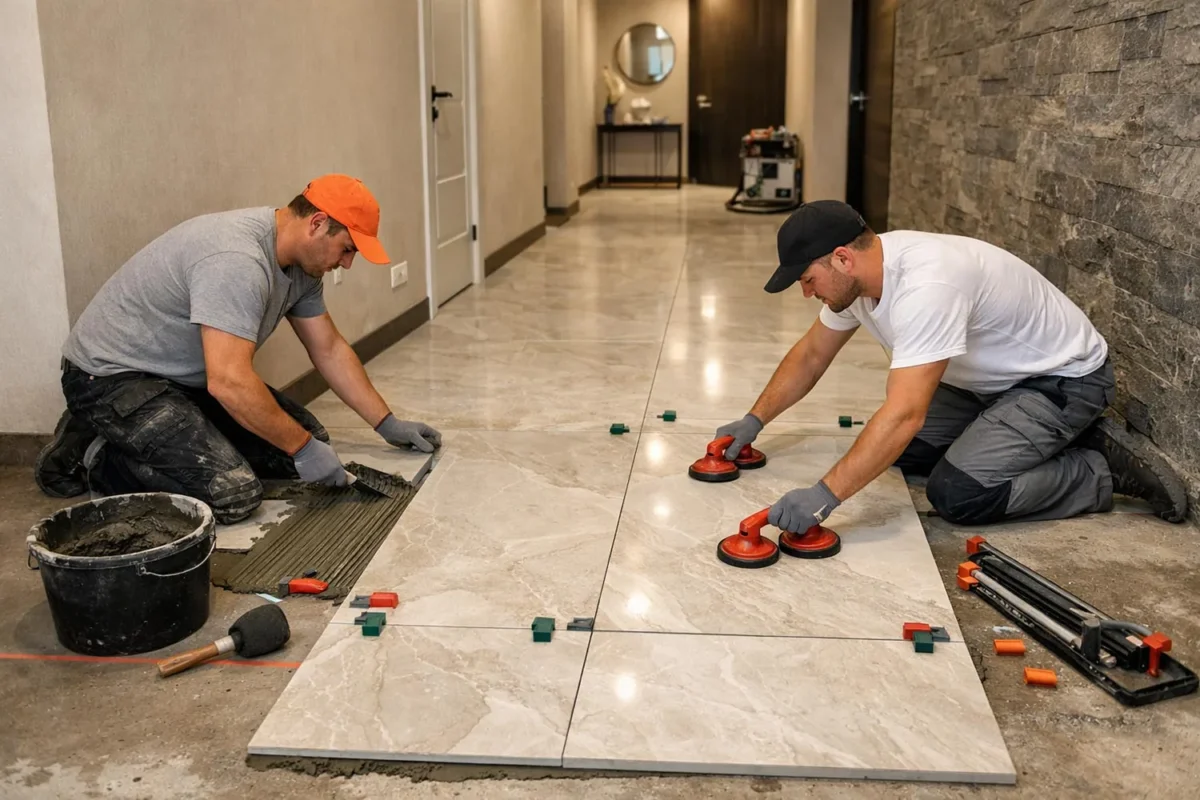
The hallway and corridor are the calling card of your home, the first room guests see. At the same time they are the zones with the heaviest load: constant foot traffic, outdoor shoes, humidity, dirt, dust. That is why the choice of flooring for a hallway should be as considered as possible. M-STONE offers professional services for the installation of large-format tile, porcelain stoneware and natural stone (travertine, marble, onyx) in hallways and corridors in Kyiv and across Ukraine. We will create a floor for you that withstands any load and looks flawless for years.
Why is large-format tile the best choice for a hallway?
Advantages of porcelain stoneware and natural stone for high-load zones
1. Exceptional wear resistance (class PEI IV-V)
The hallway and corridor are zones where the floor is under the most intense load. Every day you walk across the floor in outdoor shoes, carry heavy bags, bring in furniture and sometimes roll suitcases. Porcelain stoneware of wear-resistance class PEI IV-V (for public and commercial spaces) is ideal for a hallway. The material does not wear away, lose colour or get scratched even after decades of use.
The hardness of porcelain stoneware is 6-7 on the Mohs scale (like granite). For comparison: laminate is 2-3, parquet 3-4. That means porcelain stoneware is 2-3 times stronger than wooden coverings.
2. Waterproofness and resistance to moisture
Moisture is constantly brought into a hallway from outside: rainwater, melted snow, dirt. Porcelain stoneware has water absorption below 0.5%, meaning the material does not absorb water at all. The floor does not deform, swell, go mouldy or stain. Unlike laminate, which can swell from moisture, or parquet, which darkens from water, porcelain stoneware stays unchanged.
3. Resistance to mechanical damage
A heavy bag, a suitcase, a trolley, a pram: all of these can damage laminate and leave dents in parquet. Porcelain stoneware withstands impact loads of up to 300-500 kg/cm² without chips, cracks or dents. You can safely put heavy things, furniture and shoe cabinets on the tile; it will not deform.
4. Resistance to dirt and chemical products
The hallway is the dirtiest room in an apartment or house. Street dust, sand, de-icing agents and mud are brought in on shoes. Porcelain stoneware is easy to wash with any cleaning product, from ordinary soap to aggressive cleaners. The material does not absorb dirt, grease or stains. One wipe with a damp mop is enough for the floor to look perfectly clean.
5. Easy care
Fewer joints in large-format tile (compared with standard 30×30 cm formats) mean fewer places for dirt to collect. In a 10 sq. m hallway, instead of 100-120 tiles of 30×30 cm you will have only 15-20 large-format slabs of 60×60 cm or 10-12 slabs of 80×80 cm. There are 5-10 times fewer joints, so cleaning is easier and quicker.
6. Aesthetics and visual widening of the space
Large-format tile creates the effect of a monolithic, whole surface. A minimum of joints makes the floor look bigger and the space more spacious. For small hallways (5-8 sq. m) this is especially relevant: a large tile format of 60×60 cm or 60×120 cm creates a feeling of volume.
Colour solutions for widening the space
- Light shades (white, beige, light grey) reflect light and visually enlarge the hallway.
- Diagonal laying is an optical illusion that makes a corridor look wider.
- A glossy surface creates a mirror-shine effect and widens the space.
7. Durability (50+ years)
Porcelain stoneware and natural stone last for decades without losing their appearance. Laminate in a hallway wears out in 5-7 years, parquet needs sanding every 10 years, while large-format tile looks like new after 30, 40, 50 years. That is a saving in the long run.
8. Fire safety
Porcelain stoneware is a non-combustible material of class NG. It does not ignite or release toxic gases when heated. This matters for your family’s safety.
9. Hygiene
Tile does not accumulate dust, bacteria, fungi or allergens. For people with allergies, asthma or sensitive skin, porcelain stoneware is the safest choice.
Disadvantages of tile in a hallway and how to eliminate them
Disadvantage 1: ‘The tile is cold’
The solution: install underfloor heating (an electric cable or mat). Porcelain stoneware has excellent thermal conductivity, so the heating system works efficiently. A floor temperature of 26-28°C ensures comfort even in winter.
Disadvantage 2: ‘The tile is slippery when wet’
The solution: choose matt, structured tile with anti-slip properties of class R10, R11. Such tile has a rough surface that allows safe movement even in wet shoes.
Disadvantage 3: ‘It is expensive’
The solution: if you take into account the cost of ownership over 20-30 years, tile turns out cheaper than laminate. Laminate has to be replaced every 5-7 years in a hallway, while tile lasts 50+ years with no repair costs.
Which kinds of large-format tile suit a hallway and corridor?
1. Porcelain stoneware imitating natural stone (granite, slate, basalt)
Advantages
- Maximum wear resistance (PEI V).
- Resistance to scratches and chips.
- An anti-slip surface (R11, R12).
- It ‘camouflages’ dirt: on a dark, mottled surface dust and shoe marks are less noticeable.
Popular collections
- Cerrad Apenino Antracyt 60×60 cm, imitating dark basalt.
- Paradyz Taranto Grys 59.8×59.8 cm, imitating grey granite.
- Tubadzin Terraform Graphite 119.8×119.8 cm, imitating graphite slate.
Which style it suits: modern, minimalist, loft, industrial.
2. Concrete-look porcelain stoneware
Advantages
- A modern, urban look.
- A matt, rough surface (not slippery).
- Practical: dirt is less noticeable on a grey background.
- Easily combined with any interior style.
Popular collections
- Imola Micron 2.0 M260 Grey 120×260 cm, large-format concrete.
- Pamesa Essen Grafito 60×120 cm, graphite concrete.
- Rocersa Habitat Grey 59.5×119.2 cm, light-grey concrete.
Which style it suits: loft, hi-tech, modern, minimalist.
3. Wood-look porcelain stoneware
Advantages
- The aesthetics of natural wood without its drawbacks (not afraid of moisture, does not wear away).
- Visual warmth, coziness.
- A large choice of textures: oak, ash, walnut, teak, larch.
Popular collections
- Cerrad Mattina Sabbia 120×20 cm, imitating natural oak.
- Atlas Concorde Axi Dark Oak 120×20 cm, imitating dark oak.
- Paradyz Trophy Bianco 20×120 cm, imitating bleached ash.
Which style it suits: Scandinavian, eco style, Provence, classic.
Laying pattern: ‘herringbone’, brick bond, parallel. It imitates parquet laying.
4. Marble-look porcelain stoneware
Advantages
- A luxurious, elegant look.
- The effect of expensive natural marble.
- Resistance to stains (unlike real marble).
Popular collections
- Porcelanosa Bottega Caliza 60×120 cm, imitating white Calacatta marble.
- Imola The Room STA612 120×120 cm, imitating Statuario marble.
- Pamesa Marbles Carrara 75×75 cm, imitating Carrara marble.
Which style it suits: classic, neoclassical, art deco, modern luxury.
A nuance: light marble-look porcelain stoneware in a hallway needs more frequent cleaning, because dirt is more visible on a white background. We recommend fitting a doormat to trap dirt.
5. Natural travertine
Advantages
- Real natural stone.
- Warm beige, cream and walnut shades.
- A natural texture with pores and inclusions.
- Resistance to mechanical damage.
Formats: slabs of 40×60 cm, 60×60 cm, 60×120 cm. Thickness: 12-15 mm (for increased load).
Surface finish
- Brushed: light roughness, anti-slip.
- Tumbled: artificially aged, with relief.
- Polished: glossy (not recommended for a hallway because it is slippery).
Which style it suits: Mediterranean, classic, eco style, ethnic.
Care: needs a water-repellent treatment (Lithofin, Fila) once every 1-2 years to protect against stains.
6. Natural granite
Advantages
- The strongest natural stone (hardness 7 on the Mohs scale).
- Practically invulnerable to scratches, impacts and abrasion.
- Waterproof (water absorption < 0.4%).
- It serves for centuries.
Popular kinds of granite
- Pokostivskyi granite (Ukraine): grey-pink, red.
- Absolute Black (India): black glossy.
- Baltic Brown (Finland): brown with black inclusions.
Formats: slabs of 60×60 cm, 60×120 cm, 120×240 cm slabs.
Which style it suits: classic, luxury, monumental style.
The process of installing large-format tile in a hallway: stages of work from M-STONE
Stage 1: consultation and a specialist’s visit
What we do
📏 We measure the area of the hallway and corridor and take niches, doors and thresholds into account.
🏗️ We assess the condition of the base: a concrete screed, old tile, a wooden floor.
🎨 We show tile samples: porcelain stoneware, travertine, granite in different formats, colours and textures.
🌡️ We discuss the need for underfloor heating: an electric mat or cable.
💡 We give recommendations on choosing anti-slip tile (R10, R11), grout and thresholds.
📋 We draw up an estimate with transparent pricing.
Stage 2: preparing the base
Removing the old covering (if needed):
- We remove old parquet, laminate, linoleum and tile.
- We clean the concrete base of adhesive, mastic and paint residues.
Assessing and levelling the base
- We check the level with a laser level.
- Permissible differences for large-format tile are 2-3 mm over 2 metres.
- If the differences are more than 5 mm, we make a new screed or use self-levelling mixes.
Waterproofing (if the hallway is on the ground floor of a private house)
- We apply bitumen or polymer waterproofing to protect against groundwater.
Installing underfloor heating (optional)
- We lay the electric cable or mat across the area of the hallway.
- We connect it to the thermostat.
- We pour a 3-5 cm layer of self-levelling mix over it.
Priming
- We apply a deep-penetration primer to strengthen the base and improve the adhesion of the adhesive.
Preparation time: 2-4 days depending on the scope of work.
Stage 3: choosing the adhesive mix and grout
Adhesive for large-format tile in a hallway
For high loads we use adhesive of class C2 (increased adhesion) or S1 (flexible).
Recommended brands:
- Ceresit CM 17: universal for porcelain stoneware.
- Knauf Flex: flexible, for unstable bases.
- Mapei Keraflex Maxi S1: for large formats.
- Sopro No. 1 Plus: a premium adhesive with increased adhesion.
Grout for the joints
For a hallway the best choice is epoxy grout (Litokol Starlike, Mapei Kerapoxy):
- Completely waterproof.
- It does not absorb dirt, grease or stains.
- It does not yellow or darken over time.
- Resistant to mechanical loads.
An alternative is cement grout with a water-repellent additive (Ceresit CE 40, Mapei Ultracolor Plus).
Grout colour
For a hallway we recommend:
- Dark grout (graphite, black, brown): dirt is less noticeable on it.
- Grout matching the tile: for the effect of a seamless surface.
Stage 4: laying the large-format tile
The tile layout
Before work begins we lay the tile out dry to determine:
- The best pattern.
- Symmetry.
- How to avoid small trimmed pieces at doors.
The way of laying
The most popular for a hallway:
- A straight row: classic laying in rows.
- Diagonal: visually widens a narrow corridor.
- Offset (brick bond): for wood-look porcelain stoneware.
Applying the adhesive
We use the ‘pull-off’ method: we apply the adhesive to both the base (with a 10-12 mm notched trowel) and the tile. This ensures 100% coverage and no voids.
Laying the tile
- We carefully place the tile on the adhesive.
- We use a vibrating suction cup for heavy slabs.
- We install a levelling system for even joints of 2-3 mm.
- We check the level with a laser level, a straightedge and a spirit level.
- We tap with a rubber mallet to remove air.
Trimming the tile
For complex trimming (corners, pipes, doors) we use:
- An electric tile cutter with a diamond blade.
- An angle grinder with a diamond disc for shaped cut-outs.
A technological break
After laying, do not walk on the tile for 24-48 hours until the adhesive has fully dried.
Stage 5: grouting and final finishing
Grouting (2-3 days after laying)
- We remove the levelling clips and clean the joints.
- We dampen the joints (for cement grout).
- We apply the grout with a rubber float in diagonal movements.
- We level the joints with a grouting trowel.
- After 15-30 minutes we wash off the residues with a damp sponge.
- Polishing the tile with a dry cloth.
Fitting thresholds
Between the hallway and other rooms (the living room, kitchen) we fit decorative thresholds:
- Metal (aluminium, stainless steel, brass).
- Wooden (to match the doors).
- Rubber (flexible, for curved junctions).
Protecting natural stone
If you have chosen travertine or granite, we treat the surface with a water-repellent product (Lithofin, Fila, Akemi) to protect it from stains.
Stage 6: fitting skirting
For a finished look we fit skirting:
- Ceramic (from the same collection as the tile).
- MDF or wooden (to match the doors).
- Aluminium (a modern style).
Design solutions for a hallway and corridor
Visually widening a narrow corridor
The problem: a narrow corridor 1.2-1.5 m wide looks cramped.
The solution
- Diagonal tile laying: an optical illusion of a wider space.
- Light tile: white, beige and light grey reflect light.
- A large format: 60×120 cm or 80×80 cm creates a feeling of space.
- A glossy surface: a mirror shine visually doubles the width of the corridor.
- Lengthwise stripes: laying wood-look tile along the corridor (parallel to the walls) visually lengthens the space.
Zoning the hallway
The entrance zone (1-2 m² by the door)
- Dark, anti-slip granite-look or concrete-look tile (R11).
- This is where there is most dirt; a dark surface ‘camouflages’ stains.
- It is recommended to fit a door grille or mat to trap dirt.
The main zone of the hallway
- Light marble-look or wood-look tile.
- It looks bigger and cleaner.
The transition to living rooms
- A decorative threshold or a change of material (tile → parquet).
Combining materials
Porcelain stoneware + parquet
- The hallway: practical stone-look tile.
- The living room: warm parquet.
- The transition is finished with a metal or wooden threshold.
Porcelain stoneware in different colours
- The entrance zone: dark granite-look porcelain stoneware.
- The main part: light marble-look.
- Geometric zoning, contrast.
Porcelain stoneware + a decorative insert
- The main floor: plain tile.
- In the centre: a decorative mosaic or a natural stone panel.
Why choose M-STONE for installing tile in a hallway?
Our advantages
✅ 10+ years of experience installing large-format tile, porcelain stoneware and stone.
✅ A professional team: certified craftsmen with a portfolio.
✅ Modern equipment: laser levels, levelling systems, professional tile cutters.
✅ Transparent pricing: a detailed estimate with no hidden surcharges.
✅ Work in all districts of Kyiv: Pechersk, Shevchenkivskyi, Holosiivskyi, Obolon, Podil, Solomianka, Sviatoshyn, Desnianskyi, Darnytskyi, Dniprovskyi.
✅ Help choosing materials: we accompany you to tile showrooms and advise.
✅ A comprehensive approach: from consultation to turnkey handover of the site.
Portfolio: hallways we have created
A loft-style hallway, Pechersk
- Area: 12 sq. m
- Material: porcelain stoneware Imola Micron 2.0 Grey 120×260 cm (concrete-look)
- Laying: a straight row
- Grout: graphite epoxy
- Underfloor heating: Devi electric mat
- Duration: 4 working days
A classic-style hallway, Holosiivskyi district
- Area: 8 sq. m
- Material: porcelain stoneware Porcelanosa Bottega Caliza 60×120 cm (marble-look)
- Laying: book-match
- Grout: white epoxy
- Duration: 3 working days
A corridor in a private house, Vyshneve
- Area: 20 sq. m
- Material: Classic Light travertine 60×60 cm
- Finish: brushed, anti-slip
- Grout: beige cement
- Duration: 5 working days
A modern-style hallway, Obolon
- Area: 10 sq. m
- Material: wood-look porcelain stoneware Cerrad Mattina 120×20 cm
- Laying: ‘herringbone’
- Underfloor heating: Nexans electric cable
- Duration: 4 working days
View photos
- Instagram: https://www.instagram.com/mstone_kiev/
- Facebook: https://www.facebook.com/mstone.kyiv/
- YouTube: https://www.youtube.com/@M-Stone_Kyiv/
How to order the installation of large-format tile in a hallway?
M-STONE contacts
📞 +38 068 100 27 96📞 +38 050 914 18 99✉️ [email protected]
🌐 Website: https://mstone.ua/
📱 Social networks:
- Instagram: https://www.instagram.com/mstone_kiev/
- Facebook: https://www.facebook.com/mstone.kyiv/
- YouTube: https://www.youtube.com/@M-Stone_Kyiv/
Stages of cooperation
- A call: agreeing the time of the specialist’s visit.
- An estimate: a detailed calculation of the cost of work and materials.
- A contract: signed with guarantees.
- Purchasing materials: we help with the choice.
- Installation: carrying out the work to the schedule.
- Handing over the site: acceptance, a guarantee certificate.
Advice from M-STONE experts
How to choose tile for a hallway?
Wear resistance: choose class PEI IV or PEI V (for a high load).
Slip resistance: a matt, structured surface of class R10 or R11.
Colour: dark shades are more practical because dirt is less noticeable. Light ones visually enlarge the space.
Format: for small hallways, 60×60 cm, 60×120 cm. For large ones, 80×80 cm, 120×120 cm.
Matt or glossy tile?
Matt is practical, not slippery and shows less dirt. Recommended for a hallway.
Glossy widens the space but is slippery when wet, and shoe marks show more on it.
Is underfloor heating needed in a hallway?
Yes, it is recommended. Especially if the hallway is on the ground floor or in a private house. Underfloor heating at 26-28°C ensures comfort in winter and dries wet shoes faster.
Which grout is better for a hallway?
Epoxy is the best choice. It does not absorb dirt, does not darken and is easy to wash. The colour: graphite or matching the tile.
An alternative is cement grout with a water-repellent additive (cheaper, but less resistant to staining).
How to care for tile in a hallway?
Daily: sweeping or dry cleaning with a mop.
2-3 times a week: damp cleaning with a neutral cleaning product.
For natural stone (travertine, granite): a water-repellent treatment once every 1-2 years.
A doormat: fit a grille mat or an entrance dirt-trapping system to trap dirt from outside.
Frequently asked questions
1. How long does laying tile in a 10 sq. m hallway take?
With a ready base, 3-4 working days. With preparation and underfloor heating, 6-8 days.
2. Can tile be laid over old tile?
Yes, if the old tile holds firmly and has no cracks. We prime the base with an adhesion primer (Ceresit CT 17, Knauf Betokontakt).
3. What joint thickness is optimal?
For a hallway, 2-3 mm (large-format tile). Narrow joints look aesthetic and are less prone to staining.
4. Which is better for a hallway: porcelain stoneware or natural stone?
Porcelain stoneware is cheaper, more resistant to stains and easier to care for. Natural stone (granite, travertine) is more prestigious and unique, but more expensive.
7. Can a hallway be done without thresholds?
Yes, if the floor level is the same in all rooms. But thresholds protect the tile edges from chips.
A hallway with large-format tile is a practical solution for decades
✔️ Wear resistance: withstands a high load✔️ Waterproofness: not afraid of moisture, snow or dirt✔️ Easy care: quick cleaning✔️ Durability: 50+ years without repair✔️ Aesthetics: a modern, respectable look✔️ Hygiene: does not accumulate allergens
Create the ideal hallway with M-STONE!
📞 +38 068 100 27 96 | +38 050 914 18 99✉️ [email protected]🌐 https://mstone.ua/
M-STONE: your reliable partner in creating practical and beautiful interiors. Kyiv and all of Ukraine.
The current cost of work for your project can be calculated in the online calculators or confirmed by the manager: it depends on the material, the slab format and the condition of the substrate. The consultation is free.

About M-STONE
This material was prepared by the M-STONE team: 20 years of brand history, installation of large-format tile and natural stone in Kyiv and across Ukraine. The company is led by Oleg Dolynskyi. The recommendations describe the typical order of work; a specialist refines the solution for your project after a consultation.
Contact us
We will price your project
Send the dimensions and slab format: we will calculate the material and installation and suggest the timing.