Large-Format Tile vs Natural Stone: What to Choose for Your Project
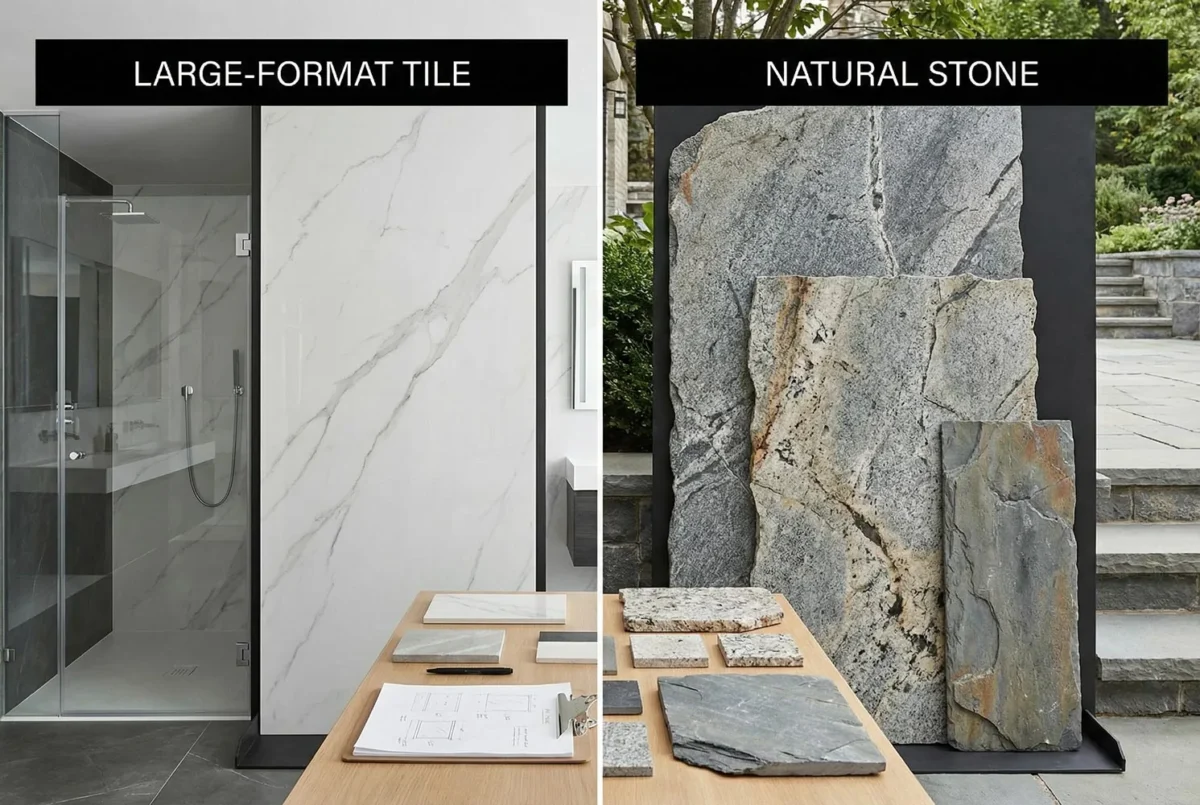
The eternal dilemma: natural uniqueness or technological perfection
When it comes to choosing premium facing materials, most clients face a difficult choice: natural stone with its unique beauty and history, or large-format porcelain stoneware with its practicality and predictability? Both options have their supporters, and both can create an interior of the highest level. But which one is right for you?
M-STONE works professionally with both natural stone and large-format tile. We will help you make an informed choice, taking into account your needs, budget and conditions of use.
Natural stone: millions of years of history in your home
What natural stone is
Natural stone is a rock formed over millions of years under the influence of geological processes. Every piece of stone is unique, because nature never repeats itself.
The main kinds of natural stone for interiors
Marble
- A metamorphic rock of recrystallised limestone
- Characteristic veining and patterns
- Soft (3-4 on the Mohs scale)
- Sensitive to acids
Granite
- An igneous rock
- A granular structure
- Hard (6-7 on the Mohs scale)
- High resistance
Travertine
- A sedimentary rock
- Characteristic pores and cavities
- A warm look
- Sensitive to acids
Onyx
- A translucent stone
- Unique patterns
- Soft and delicate
- The possibility of lighting
Quartzite
- A metamorphic rock
- High hardness
- A variety of colours
- Resistance to impacts
Slate
- A layered structure
- A natural texture
- Different colours
- High strength
Advantages of natural stone
Uniqueness Every slab is one of a kind. The pattern, colours and veining are all the result of millions of years of natural processes. You cannot find two identical slabs.
Natural beauty Depth of colour, the play of light on the surface, the tactile feel: natural stone has a special energy that cannot be fully reproduced artificially.
Prestige and status For centuries natural stone has been associated with luxury, wealth and refined taste. Marble palaces, granite cathedrals: stone has always been the material for special projects.
Eco-friendliness A 100% natural material without chemical additives. It is quarried, processed and used without harm to health.
Durability With correct care natural stone serves for centuries. The marble floors of Roman palaces have survived to this day.
Investment value Quality natural stone does not lose its value over time and often even increases it. It raises the value of the property.
The possibility of restoration Natural stone can be ground, polished and restored. Scratches and damage are repaired without replacing the material.
Thermal conductivity Stone works well with underfloor heating systems, distributing heat effectively.
Disadvantages of natural stone
Porosity Most natural stones (especially marble and travertine) have pores that absorb liquids and can leave stains.
Sensitivity to chemicals Carbonate stones (marble, travertine, limestone) react to acids: lemon juice, vinegar and wine leave matt marks (etching).
The need for care Natural stone needs regular water-repellent treatment, special cleaning products and careful handling.
Variability What is an advantage (uniqueness) can be a disadvantage: it is hard to match identical slabs, and the colour may differ from the sample.
Size limits The size of slabs is limited by the size of the quarried blocks. Large slabs are more expensive and harder to process.
Weight Natural stone is heavy (marble ~2700 kg/m³), which puts load on structures and makes installation harder.
Cost Quality natural stone, especially of rare kinds, costs considerably more than porcelain stoneware.
Complexity of processing Cutting, polishing and making complex shapes need special equipment and craftsmanship.
Large-format porcelain stoneware: technological perfection
What porcelain stoneware is
Porcelain stoneware (gres, porcelain tile) is an artificial material made from natural raw materials (clay, kaolin, feldspar, quartz sand) by pressing and firing at a temperature of 1200-1300°C.
Types of large-format porcelain stoneware
Technical porcelain stoneware
- A uniform structure throughout the thickness
- Maximum strength
- For industrial sites
Glazed porcelain stoneware
- A decorative layer on the surface
- A variety of designs
- For residential rooms
Polished porcelain stoneware
- A mechanically polished surface
- A mirror shine
- For formal rooms
Full-body
- The pattern runs through the whole thickness
- Chips are less noticeable
- The premium segment
Advantages of porcelain stoneware
Practically zero water absorption Water absorption below 0.05%: the material is completely waterproof and does not absorb liquids or stains.
Chemical resistance Resistant to acids, alkalis and household chemicals. It can be cleaned with any products.
High hardness Hardness of 7-8 on the Mohs scale (comparable to granite). Resistance to scratches.
Wear resistance Class PEI V is the maximum wear resistance. Suitable for the most intensive conditions of use.
Frost resistance It withstands an unlimited number of freeze-thaw cycles. Ideal for outdoors.
Predictability All slabs from one batch are identical. Easy to match, replace or add to.
Large formats Slabs up to 160×320 cm are available, larger than most natural stone slabs.
Lighter weight A thickness of 6-12 mm while keeping strength. Less load on structures.
Easy care No need for a water-repellent treatment or special products. Ordinary washing.
Cost Much more affordable than natural stone of a similar look.
A variety of designs Imitation of any materials: marble, wood, concrete, metal. Fantasy designs.
Stable characteristics The colour does not fade, and the surface does not change over time.
Disadvantages of porcelain stoneware
Artificiality On close inspection it differs from natural stone. The pattern repeats (although modern technologies minimise this).
The impossibility of restoration Deep scratches and chips cannot be repaired by grinding; the tile can only be replaced.
Brittleness on impact Despite its hardness, it may crack or chip if heavy objects fall on it.
‘Coldness’ Some consider porcelain stoneware less ‘alive’ than natural stone.
Difficulty of cutting large formats It needs special equipment and experience.
Slipperiness of the polished kind Polished porcelain stoneware is very slippery when wet.
A detailed comparison by criteria
Appearance and aesthetics
Natural stone
- The uniqueness of every slab: 10/10
- Depth of colour: 10/10
- Natural beauty: 10/10
- Tactile feel: 10/10
Porcelain stoneware
- Stone imitation: 8/10 (the best collections 9/10)
- Consistency: 10/10
- A variety of designs: 10/10
- Large formats: 10/10
Conclusion: for connoisseurs of real natural beauty, natural stone. For those who value predictability and a wide choice, porcelain stoneware.
Practicality and care
| Criterion | Natural stone | Porcelain stoneware |
|---|---|---|
| Water resistance | Needs protection | Absolute |
| Stain resistance | Low to medium | High |
| Resistance to acids | Low (marble) | High |
| Resistance to scratches | Medium | High |
| Ease of cleaning | Medium | High |
| The need for care | High | Low |
Conclusion: porcelain stoneware is much more practical. Natural stone needs a conscious approach and regular care.
Durability
Natural stone
- Service life: 100+ years
- The possibility of restoration: yes
- Ageing: it acquires a patina (for some, an advantage)
Porcelain stoneware
- Service life: 50+ years
- The possibility of restoration: no (replacement only)
- Ageing: it does not change
Conclusion: both materials are extremely durable. Stone can be restored, porcelain stoneware cannot, but it does not need restoring.
Cost
Natural stone
- Finishing: a high cost
- Installation: more expensive (heavier, more complex)
- Care: regular costs
Porcelain stoneware
- Finishing: included in the cost
- Installation: standard cost
- Care: minimal costs
Conclusion: porcelain stoneware is much more affordable in terms of total cost of ownership.
Eco-friendliness
Natural stone
- A 100% natural material
- Extraction affects the landscape
- Transport (often from other continents)
- Durability offsets the impact
Porcelain stoneware
- Natural raw materials
- Energy-intensive production
- Local production is possible
- Recycling is limited
Conclusion: both materials have their environmental aspects. Neither is unambiguously ‘greener’.
Recommendations on choice by type of room
Bathroom
Natural stone
- Marble: a luxurious look, but it needs protection
- Travertine: warm, cozy, needs a water-repellent treatment
- Onyx: exclusive, with backlighting
Porcelain stoneware
- A more practical choice
- Not afraid of water and chemicals
- Marble imitation: aesthetics without the bother
An M-STONE recommendation: for a heavily used bathroom, porcelain stoneware. For a master bathroom treated with care, natural stone will create a spa atmosphere.
The kitchen
Work surfaces (countertops)
- Granite: practical and beautiful
- Quartzite: a premium choice
- Marble: for connoisseurs (be ready for patina)
- Porcelain stoneware: practical and stylish
Floors
- Porcelain stoneware is unambiguously more practical
- Stone is possible but needs care
Backsplash
- Both options are suitable
- Porcelain stoneware is easier to care for
An M-STONE recommendation: the countertop is down to your aesthetic preferences and readiness to look after it. The floor: porcelain stoneware.
Living room
Natural stone
- Marble: classic elegance
- Travertine: warm coziness
- Granite: practicality and style
Porcelain stoneware
- Large formats: a minimum of joints
- Marble imitation: affordable luxury
- Wood imitation: warmth and practicality
An M-STONE recommendation: for a formal living room, natural stone as an investment and a status symbol. For a practical approach, large-format porcelain stoneware.
Commercial premises
Offices, hotels, restaurants
- Entrance areas: natural stone for a wow effect
- Transit areas: porcelain stoneware for practicality
- VIP areas: natural stone
Shopping centres
- Porcelain stoneware, unambiguously (wear resistance, ease of replacement)
An M-STONE recommendation: combine them: natural stone for accents and formal areas, porcelain stoneware for practical ones.
Exterior work
Terraces, paths
- Heat-treated granite: maximum durability
- Antiqued travertine: warmth and slip resistance
- 20 mm porcelain stoneware: practicality and style
Pools
- Edges: travertine is ideal
- Walkways: travertine or porcelain stoneware
- The basin: porcelain stoneware or mosaic
Facades
- Natural stone: status and durability
- Porcelain stoneware: lighter, cheaper, more varied
An M-STONE recommendation: for exterior work both materials are suitable if chosen correctly. Take frost resistance and slip resistance into account.
Combining materials is the best solution
Why combining is effective
Combining natural stone and porcelain stoneware lets you get the advantages of both materials:
- Stone for accents and formal areas
- Porcelain stoneware for practical and transit areas
Examples of successful combinations
A living room + an open-plan kitchen
- The living room: a marble floor (the formal area)
- The kitchen: marble-look porcelain stoneware (the practical area)
- Visual unity, different functionality
Bathroom
- An accent wall: natural onyx with backlighting
- The remaining walls and floor: porcelain stoneware
- A luxury effect at a reasonable price
Steps
- Steps: natural stone
- Landings: porcelain stoneware
- A combination of beauty and practicality
A hotel lobby
- The central part: a marble panel
- Transit areas: porcelain stoneware
- A wow effect + practicality
How to make the right choice
Questions for self-determination
1. What matters more to you: uniqueness or practicality?
- Uniqueness → natural stone
- Practicality → porcelain stoneware
2. Are you ready for regular care?
- Yes, it is part of owning beauty → stone
- No, I want ‘install and forget’ → porcelain stoneware
3. What is your budget?
- No limits → stone
- Optimised → porcelain stoneware or a combination
4. What is the purpose of the room?
- Formal → stone
- Practical → porcelain stoneware
- Combined → a combination
5. Are there children or pets?
- Yes → porcelain stoneware is more practical
- No → both options
6. How long do you plan to live in this house?
- For ever → stone as an investment
- Uncertain → porcelain stoneware
Contact information
M-STONE: we will help you choose the ideal material
📞 Phones: +38 068 100 27 96, +38 050 914 18 99 📧 Email: [email protected] 🌐 Website: https://mstone.ua/
Social media
- Instagram: https://www.instagram.com/mstone_kiev/
- Facebook: https://www.facebook.com/mstone.kyiv/
- YouTube: https://www.youtube.com/@M-Stone_Kyiv/
Geography of work
Kyiv: all districts Kyiv region: Brovary, Irpin, Bucha, Vyshhorod, Vyshneve, Boiarka, Kozyn, Koncha-Zaspa and others All of Ukraine: travel to projects
M-STONE’s advantages
✅ Work with both materials: stone and porcelain stoneware ✅ An honest consultation: we will advise the best option ✅ Our own production: stone processing ✅ Large formats: up to 160×320 cm ✅ Combined projects: a harmonious combination ✅ A full cycle: from choice to installation
The current cost of work for your project can be calculated in the online calculators or confirmed by the manager: it depends on the material, the slab format and the condition of the substrate. The consultation is free.

About M-STONE
This material was prepared by the M-STONE team: 20 years of brand history, installation of large-format tile and natural stone in Kyiv and across Ukraine. The company is led by Oleg Dolynskyi. The recommendations describe the typical order of work; a specialist refines the solution for your project after a consultation.
Contact us
We will price your project
Send the dimensions and slab format: we will calculate the material and installation and suggest the timing.