Laying Large-Format Tile on the Floor: Technology and Secrets from M-STONE
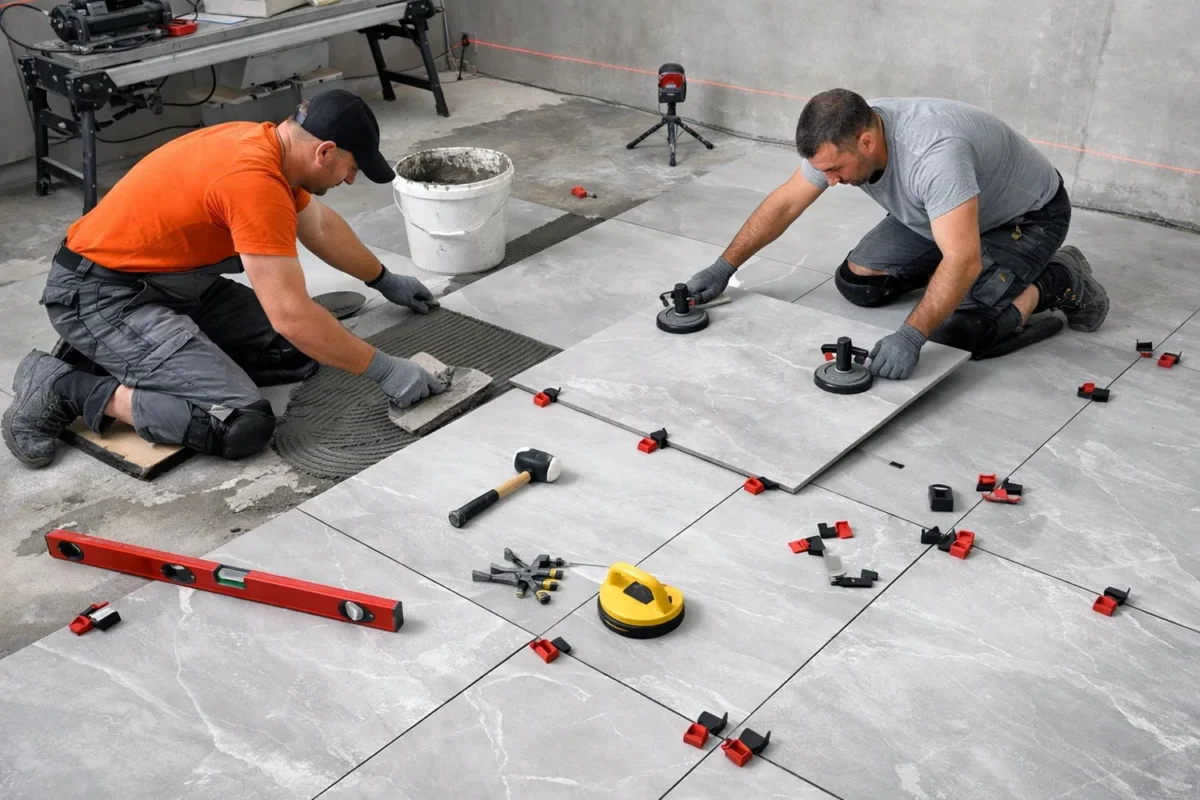
A large-format tile floor is a modern quality standard
Large-format tile on the floor is not just a trend but the new standard of modern renovation. Slabs of 60×120, 80×160, 120×120, 120×240 and even 160×320 cm create the effect of a monolithic surface, visually widen the space and give the interior status and elegance. However, laying such tile calls for special knowledge, skills and equipment.
M-STONE is a leader in laying large-format tile on floors in Kyiv and Ukraine. Our specialists have many years of experience with tile of any size, including the largest slabs, as well as with natural stone: travertine, marble and onyx.
Why is large-format tile on the floor the right choice?
Aesthetic advantages
A minimum of joints, a maximum of beauty The main advantage of a large format is a much smaller number of joints. If laying 30×30 cm tile over 10 m² means more than 100 tiles and a corresponding number of joints, a 120×120 cm format needs only 7-8 slabs. The result is an almost monolithic surface.
Imitation of natural stone Modern printing technologies let porcelain stoneware imitate marble, travertine, onyx and other stones perfectly. A large format makes it realistic: veining and patterns are not interrupted by joints.
Visual widening of the space Large slabs without numerous joints create the illusion of a bigger room. This is especially valuable for small apartments, where every square metre counts.
A modern look Large-format tile is a sign of a modern premium-class renovation. It underlines the owner’s status and attention to detail.
Practical advantages
Hygiene Fewer joints mean fewer places for dirt, bacteria and mould to build up. This is especially important for kitchens, bathrooms and rooms with higher hygiene requirements.
Easy cleaning A smooth surface without numerous joints makes washing and keeping it clean much easier. There is no need to scrub the grout between tiles.
Durability Quality porcelain stoneware has a hardness of 8-9 on the Mohs scale (close to the hardness of diamond), which ensures resistance to scratches and wear for decades.
Moisture resistance The water absorption of porcelain stoneware is below 0.05%, which makes it ideal for bathrooms, kitchens, swimming pools and even outdoors.
Chemical resistance Porcelain stoneware does not react to acids, alkalis and most aggressive substances, unlike natural stone.
Heat resistance The tile withstands significant temperature changes and works perfectly with underfloor heating systems.
Types of large-format tile for floors
By material
Porcelain stoneware (Gres Porcellanato) The most popular material for floors. It is made by pressing and firing at a temperature above 1200°C.
Characteristics:
- Water absorption: below 0.05%
- Hardness: 8-9 on the Mohs scale
- Frost resistance: down to -50°C
- Wear resistance: PEI IV-V
Large-format ceramic tile Traditional ceramics, but in large sizes. It has higher water absorption (up to 3%) and is less suitable for floors with heavy loads.
Natural stone Marble, travertine and granite in slab format. A premium segment with unique natural beauty.
Ceramic stone A modern material based on natural minerals with added polymers. It combines the properties of ceramics and natural stone.
By type of surface
Matt (Naturale / Matt)
- A natural surface without additional treatment
- Maximum slip resistance (R10-R11)
- The highest wear resistance
- Scratches are not visible
- Recommended for: hallways, kitchens, public spaces
Polished (Lucido / Polished)
- A mirror shine
- A striking appearance
- Low slip resistance (R9)
- Scratches and marks are visible
- Recommended for: living rooms, bedrooms, rooms with a low load
Lappato (Lappato / Semi-polished)
- A partly polished surface
- A combination of matt and glossy areas
- Moderate slip resistance
- The best compromise between aesthetics and practicality
- Recommended for: most residential rooms
Satin (Satinato / Satin)
- A soft silky shine
- Pleasant to the touch
- Good slip resistance
- Recommended for: bedrooms, bathrooms
Structured (Strutturato / Textured)
- A pronounced surface texture
- Imitates natural stone or wood
- Maximum slip resistance (R11-R12)
- Recommended for: outdoors, terraces, swimming pools, showers
By design
Marble-look An imitation of different kinds of marble: Calacatta, Statuario, Carrara, Emperador. Realistic veining and patterns.
Travertine-look A reproduction of the texture and colour of natural travertine with characteristic pores and shades.
Onyx-look An imitation of translucent onyx, sometimes with the possibility of backlighting.
Concrete-look A fashionable industrial style with an imitation of a concrete surface in different shades.
Wood-look A realistic imitation of wood of different species and shades.
Metal-look An imitation of rusty metal, copper and bronze for loft interiors.
Monocolour A plain surface without patterns for minimalist interiors.
Terrazzo An imitation of a mosaic floor with stone chips.
Sizes of large-format floor tile
Popular formats
| Size (cm) | Slab area | Features |
|---|---|---|
| 60×60 | 0.36 m² | The start of the large format |
| 60×120 | 0.72 m² | A popular rectangle |
| 80×80 | 0.64 m² | A large square |
| 80×160 | 1.28 m² | A striking rectangle |
| 90×90 | 0.81 m² | A premium square |
| 100×100 | 1.0 m² | A one-metre square |
| 100×300 | 3.0 m² | A large slab |
| 120×120 | 1.44 m² | A popular large square |
| 120×240 | 2.88 m² | A large slab |
| 120×278 | 3.34 m² | A maxi slab |
| 160×320 | 5.12 m² | A giant slab |
Slab thickness
6 mm: for walls and light structures, not for floors 9-10 mm: the standard for residential rooms 12 mm: for commercial sites 14 mm: for high-load zones 20 mm: for outdoors, terraces, car parks (laid on gravel or supports)
Technology of laying large-format tile on the floor
Substrate preparation
The quality of the floor depends 70% on the quality of base preparation. The requirements for the base under large-format tile are much stricter than for standard sizes.
Flatness requirements
- Maximum deviation: 2 mm over 2 metres
- For slabs over 120 cm: 1 mm over 2 metres
- Checked with a laser level and a straightedge
Strength requirements
- Screed strength: at least M150
- No cracks or voids
- The screed must be completely dry (at least 28 days)
Preparatory work from M-STONE
- Removing old coverings
- Removing old tile, linoleum, parquet
- Removing adhesive and screed residues
- Removing construction waste
- Assessing the condition of the base
- Checking flatness with a laser level
- Tapping to find voids
- A moisture test
- Repairing defects
- Filling cracks with repair mixes
- Eliminating potholes and irregularities
- Strengthening weak areas
- Levelling the surface
- Laying a self-levelling screed (if necessary)
- Grinding off the protrusions
- A final flatness check
- Waterproofing
- Mandatory for bathrooms and kitchens
- Coating or roll waterproofing
- Treating corners and junctions
- Priming
- Applying a deep-penetration primer
- Improving the adhesion of the adhesive to the base
- Binding dust
Choosing the adhesive mix
For large-format tile only specialised adhesives of class C2 or higher are used.
Classification of adhesives
| Class | Adhesion | Purpose |
|---|---|---|
| C1 | ≥0.5 MPa | Ordinary tile (not for large formats) |
| C2 | ≥1.0 MPa | Large-format tile |
| C2E | ≥1.0 MPa | Extended open time (30-40 min) |
| C2F | ≥1.0 MPa | Fast-setting (walkable after 3-4 h) |
| C2S1 | ≥1.0 MPa | Flexible (for underfloor heating) |
| C2S2 | ≥1.0 MPa | Highly flexible (for wooden bases) |
Recommended brands
- Mapei (Keraflex Maxi, Kerabond T)
- Litokol (Litoflex K80, Litoelastic)
- Ceresit (CM 17, CM 117)
- Kerakoll (H40 No Limits)
Technology of applying the adhesive
For large-format tile double application of adhesive (buttering-floating) is mandatory:
Stage 1: applying to the base
- The adhesive is applied to a section of floor
- Spread with a notched trowel with a 10-15 mm tooth
- The ridges are formed in one direction
Stage 2: applying to the tile
- A thin layer of adhesive (1-2 mm) is applied to the back of the tile
- An even distribution over the whole surface
- Filling all pores and irregularities
Why is this important? Double application ensures 100% contact of the tile with the base. Voids under large-format tile mean guaranteed cracks under load.
The laying process
1. Planning the layout
- Determining the laying direction
- Calculating the position of the joints
- Planning the cuts
- Taking into account the position of furniture and equipment
2. A trial layout
- Laying out the slabs without adhesive
- Checking aesthetics and practicality
- Adjusting the plan if necessary
3. Marking
- Marking out the floor
- Determining the starting point
- Control lines for checking the straightness of the joints
4. Transporting the slab
- Using vacuum suction cups
- Moving it in a vertical position
- 2-4 people involved depending on size
5. Laying the slab
- The slab is lowered onto the adhesive, starting from one edge
- Lowered gradually to push out the air
- Lightly pressed to the base
6. Levelling
- Using a rubber mallet
- Checking the level
- Adjusting the position
7. Fixing with a levelling system (TLS)
- Fitting clips or wedges
- Ensuring even joints
- Preventing shifting before the adhesive sets
8. Removing excess adhesive
- Cleaning adhesive out of the joints
- Wiping the tile surface
- Ensuring joint depth for the grout
Grouting the joints
Grouting is done after the adhesive has fully set (usually 24-48 hours).
Types of grout for large-format tile
Cement grout
- An economical option
- Suitable for joints from 2 mm
- Needs a water-repellent treatment
- May crack over time
Epoxy grout
- A premium option
- Zero water absorption
- Resistance to chemicals and dirt
- Durability for decades
- Recommended for large-format tile
Polyurethane grout
- Elasticity
- Resistance to deformation
- Recommended for underfloor heating
Joint width
- Minimum: 1.5-2 mm (for rectified tile)
- Optimal: 2-3 mm
- Wider: 3-5 mm (to create an accent)
Features of laying in different rooms
Living room
Recommendations
- A polished or lappato surface
- Light shades for visual widening
- Laying along the long wall
- Taking furniture position into account when planning the joints
Popular designs
- Imitation of Calacatta or Statuario marble
- Light concrete
- Monocolour in beige tones
Bedroom
Recommendations
- A matt or satin surface
- Warm shades for coziness
- Underfloor heating is a must (ceramic is cold)
- The possibility of using rugs
Popular designs
- Imitation of travertine
- Wood (large slabs imitating parquet)
- Neutral shades
The kitchen
Recommendations
- A matt or structured surface (slip resistance)
- Resistance to stains and dirt
- Dark shades are more practical
- Matching with the backsplash and countertop
Popular designs
- Concrete in different shades
- Dark marble (Emperador, Nero Marquina)
- Terrazzo
Bathroom
Recommendations
- A structured or matt surface (safety!)
- Waterproofing is mandatory
- Slip-resistance class R10-R11
- A large format reduces the number of joints (less mould)
Popular designs
- White marble (Carrara, Statuario)
- Onyx (especially with backlighting)
- Travertine
Hallway / Corridor
Recommendations
- A matt surface (visibility of dirt)
- High wear resistance (PEI V)
- Dark or medium shades are more practical
- Laying along the direction of movement
Popular designs
- Graphite concrete
- Dark stone
- Terrazzo with a dark base
Terrace / Balcony
Recommendations
- A structured surface (R11-R12)
- Frost resistance
- A thickness of 20 mm for laying on supports
- A slope for water drainage (1-2%)
Popular designs
- Imitation of natural stone
- Concrete
- Wood-look (anti-slip)
A marble floor
Advantages
- Unrivalled natural beauty
- Every slab is unique
- The possibility of restoration (grinding, polishing)
- Prestige and status
Features
- Sensitivity to acids
- The need for regular care
- A higher cost of materials and work
Popular varieties
- Bianco Carrara: the classic
- Crema Marfil: a warm beige
- Emperador: a luxurious brown
A travertine floor
Advantages
- A warm natural stone
- A comfortable surface for walking barefoot
- An antique character
- A variety of finishes
Features
- A porous structure needs filling or protection
- Regular water-repellent treatment
- Sensitivity to acids
Popular options
- Classic: beige with veining
- Noce: a rich brown
- Silver: a cool grey
An onyx floor
Advantages
- Exclusivity and uniqueness
- The possibility of lighting
- A magical effect
Features
- The premium segment
- Delicate use
- Recommended for low-load zones
Application
- Inserts in a marble floor
- Decorative rosettes
- Spa areas
What the cost of the work depends on
- Size and thickness of the tile
- Condition and quality of the base
- The need for preparatory work
- Complexity of the room geometry
- Number of cuts and cut-outs
- Type of adhesive and grout
- Order volume
- Urgency of execution
What is included in the cost of M-STONE work
- Consultation and measurements
- Substrate preparation
- Laying the tile
- Grouting the joints
- Cleaning after the work
- A guarantee on the work done
The Right Bank
- Pechersk, Lypky, Zverynets
- Podil, Obolon, Vynohradar
- Sviatoshyn, Borshchahivka, Akademmistechko
- Holosiiv, Teremky, Feofaniia
- Shuliavka, Solomianka, Karavaievi Dachi
The Left Bank
- Pozniaky, Osokorky, Kharkivskyi
- Darnytsia, Lisovyi, Rusanivka
- Troieshchyna, Vyhurivshchyna, Desnianskyi
Kyiv suburbs
- Brovary, Irpin, Bucha, Vorzel
- Vyshhorod, Vyshneve, Boyarka
- Ukrainka, Obukhiv, Kozyn, Koncha-Zaspa
M-STONE contacts
📞 Phones: +38 068 100 27 96, +38 050 914 18 99 📧 Email: [email protected] 🌐 Website: https://mstone.ua/
Social media
- Instagram: https://www.instagram.com/mstone_kiev/
- Facebook: https://www.facebook.com/mstone.kyiv/
- YouTube: https://www.youtube.com/@M-Stone_Kyiv/
Why choose M-STONE?
✅ Specialisation in large formats: this is our core expertise ✅ Professional equipment: vacuum suction cups, large-format tile cutters, laser levels ✅ Experienced craftsmen: years of experience with large-format materials ✅ Work with natural stone: marble, travertine, onyx ✅ A full cycle of services: from consultation to the final result ✅ A quality guarantee: an official guarantee on all work
The current cost of work for your project can be calculated in the online calculators or confirmed by the manager: it depends on the material, the slab format and the condition of the substrate. The consultation is free.

About M-STONE
This material was prepared by the M-STONE team: 20 years of brand history, installation of large-format tile and natural stone in Kyiv and across Ukraine. The company is led by Oleg Dolynskyi. The recommendations describe the typical order of work; a specialist refines the solution for your project after a consultation.
Contact us
We will price your project
Send the dimensions and slab format: we will calculate the material and installation and suggest the timing.