Adhesive Mixes and Grouts for Large-Format Tile: How to Choose Correctly
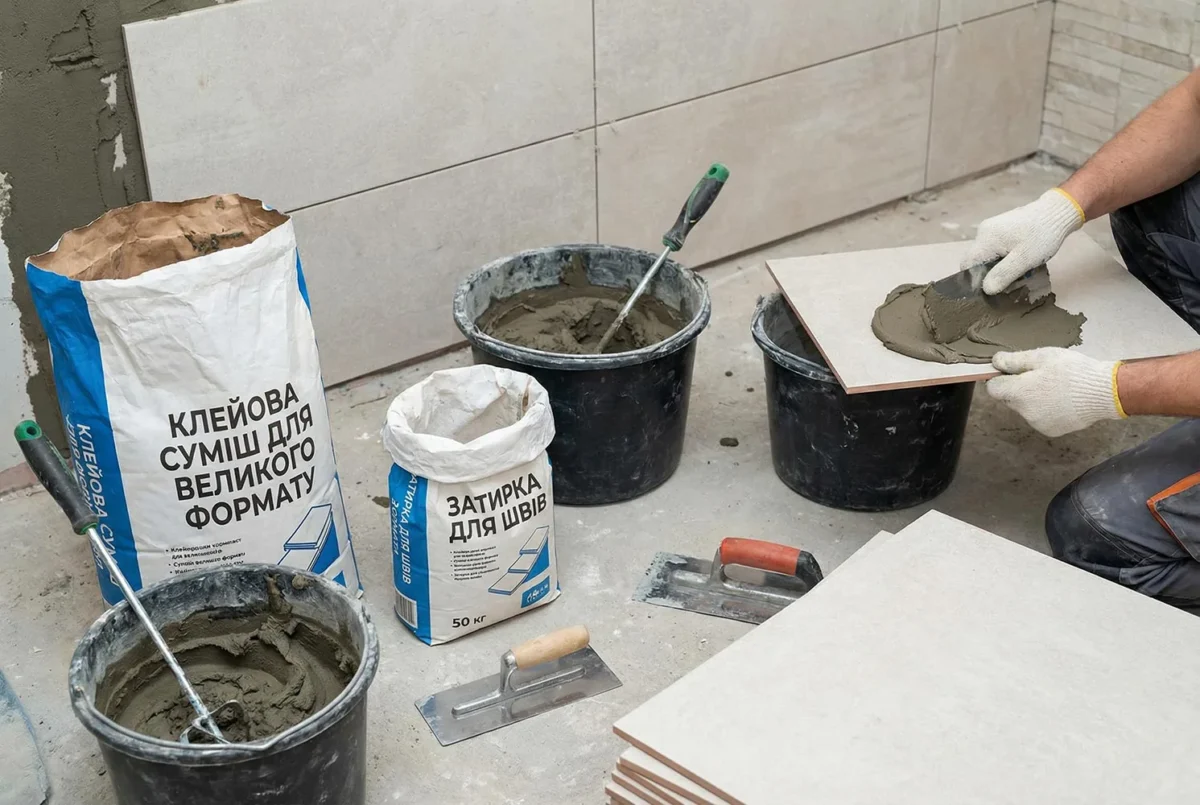
Adhesive and grout: the invisible heroes of quality installation
When we admire a flawless surface of large-format tile, we rarely think about what holds that beauty in place. Adhesive and grout are the invisible components on which the durability and reliability of the whole surface depend. A wrong choice, or saving on these materials, can undo even the most expensive tile and the best craftsmanship.
M-STONE uses only professional adhesive mixes and grouts from leading European manufacturers. We know that large-format tile and natural stone need special materials, and we make no compromises in choosing them.
Adhesive mixes for large-format tile
Why a large format needs a special adhesive
A large contact area A 120×240 cm slab has an area of almost 3 m². The adhesive must hold this whole surface evenly.
Considerable weight A porcelain stoneware slab of this size weighs 50-70 kg. For walls the adhesive must resist gravity until it has fully hardened.
Minimal deformation Large slabs do not compensate for movement of the base, so the adhesive must be flexible enough.
A long adjustment time Large slabs need more time for positioning and levelling.
100% contact Voids under a large slab mean guaranteed cracks. The adhesive must ensure full coverage.
Classification of adhesive mixes under the European standard EN 12004
Basic classes
| Class | Adhesion | Description |
|---|---|---|
| C1 | ≥0.5 MPa | Cement adhesive of normal setting |
| C2 | ≥1.0 MPa | Improved cement adhesive |
| D | – | Dispersion (ready-mixed) adhesive |
| R | – | Reactive (epoxy, polyurethane) adhesive |
Additional characteristics
| Designation | Characteristic | Meaning |
|---|---|---|
| F | Fast | Accelerated hardening |
| T | Thixotropic | Does not run down vertical surfaces |
| E | Extended | An increased open time |
| S1 | Deformable (flexible) | Deformation 2.5-5 mm |
| S2 | Highly deformable (highly flexible) | Deformation >5 mm |
Minimum requirements for large-format tile
- Class C2: mandatory
- T (thixotropic): for walls
- E (extended time): recommended
- S1/S2 (flexible): for underfloor heating, large areas, unstable bases
Types of adhesive mixes
Cement adhesives (C1, C2)
The most common type: a dry cement-based mix with polymer additives.
Composition:
- Portland cement (the binder)
- Quartz sand (the filler)
- Polymer additives (flexibility, adhesion)
- Modifiers (working time, flow)
Advantages:
- An affordable price
- A wide range
- Can be applied in a thick layer
- Compatible with most bases
Limitations:
- Needs mixing
- Limited working time
- Sensitive to temperature and humidity during application
Dispersion adhesives (D)
Ready-mixed paste adhesives based on polymer dispersions.
Advantages:
- Ready to use
- Excellent adhesion to smooth surfaces
- Elasticity
- A long open time
Limitations:
- Thin-layer application (up to 5 mm)
- Not suitable for exterior work
- A higher price
- Not for porcelain stoneware (low water absorption)
Use:
- Laying mosaics
- Tile on plasterboard
- Repair work
Reactive adhesives (R): epoxy and polyurethane
Two-component adhesives based on epoxy resins or polyurethane.
Advantages:
- The highest strength
- Chemical resistance
- Complete watertightness
- Flexibility (polyurethane ones)
- The possibility of bonding different materials
Limitations:
- A high price
- Difficult to work with
- A limited pot life
- The need for exact dosing of the components
Use:
- Pools
- Industrial sites
- Chemically aggressive environments
- Vibration loads
- Laying on metal
Choosing an adhesive depending on conditions
For floors indoors
Standard conditions:
- C2 or C2E adhesive
- Examples: Mapei Keraflex, Litokol Litoflex K80, Ceresit CM 16
Underfloor heating:
- C2S1 or C2S2 adhesive (flexible!)
- Examples: Mapei Keraflex Maxi S1, Litokol Litoelastic, Ceresit CM 17
Large areas (over 40 m²):
- C2S1 adhesive with expansion joints
- Flexibility compensates for thermal expansion
For walls indoors
Mandatory characteristics:
- Class C2T (thixotropic: it does not run!)
- Extended open time (E): desirable
Recommended adhesives:
- Mapei Keraflex Maxi S1
- Litokol Litoflex K80 Eco
- Ceresit CM 17
- Kerakoll H40 No Limits
For exterior work
Requirements:
- Class C2
- Frost resistance (at least F50)
- S1 flexibility (to compensate for thermal deformation)
Recommended adhesives:
- Mapei Kerabond T + Isolastic
- Mapei Granirapid
- Litokol Litoflex K80
For natural stone
Light stone (white marble, travertine, onyx):
- Only WHITE adhesive!
- Grey adhesive shows through porous stone
Recommended adhesives:
- Mapei Keraflex Maxi S1 White
- Litokol Litostone K98
- Kerakoll H40 No Limits White
Heavy stone (granite, thick slabs):
- A higher-strength adhesive
- Possibly a reactive adhesive for especially heavy elements
For swimming pools
Requirements:
- Complete watertightness
- Chlorine resistance
- Elasticity
Recommended adhesives:
- Mapei Keraflex Maxi S1 + Mapelastic waterproofing
- Litokol Litoelastic
- Epoxy adhesives
Technology of working with adhesive
Preparing the mix
- A clean container, a clean mixer
- Water first (per the instructions), then the dry mix
- Mixing with a mixer at low speed (400-600 rpm)
- Maturing for 5-10 minutes
- Mixing again
- The finished mix must be uniform, without lumps
Application: the double application method (buttering-floating)
Mandatory for large-format tile!
Stage 1: applying to the base:
- Apply the adhesive in an even layer to a section of the base
- Form ridges with a notched trowel (10-15 mm tooth)
- Ridges in one direction!
Stage 2: applying to the tile:
- Apply a thin layer of adhesive (1-2 mm) to the whole back of the tile
- Level it with the flat side of the trowel
- Fill all pores and irregularities
Laying:
- Place the tile onto the adhesive
- Press down, starting from one edge (to let the air out)
- Level with a spirit level
- Check: the adhesive must squeeze out on all sides of the joint
Important timing parameters
| Parameter | Standard adhesive | Adhesive marked E | Fast adhesive (F) |
|---|---|---|---|
| Working time of the mixed adhesive | 2-3 hours | 3-4 hours | 30-45 minutes |
| Open time (after application) | 15-20 minutes | 30-40 minutes | 10-15 minutes |
| Adjustment time | 20-30 minutes | 40-60 minutes | 10-15 minutes |
| Grouting the joints | after 24 hours | after 24 hours | after 3-4 hours |
| Full load | after 7-14 days | after 7-14 days | after 24 hours |
Popular adhesive brands
Mapei (Italy): the world leader
- Keraflex: the base series
- Keraflex Maxi S1: for large formats
- Kerabond + Isolastic: a flexible system
- Granirapid: fast-setting
Litokol (Italy): premium quality
- Litoflex K80: universal
- Litoelastic: highly flexible
- Litostone K98: for natural stone
Ceresit (Germany): reliability
- CM 16: flexible
- CM 17: highly flexible
- CM 22: for large formats
Kerakoll (Italy): innovation
- H40 No Limits: a universal premium
- H40 Gel: gel-like, for verticals
Grouts for large-format tile
Functions of grout
Sealing the joints Protection against water, dirt and bacteria getting in.
Compensating deformation Joints compensate for slight movement of the tile.
Aesthetics Completing the appearance of the surface.
Fixing Additional holding of the tile edges.
Types of grout
Cement grouts
The traditional type, cement-based with polymer additives.
Composition:
- White cement
- Graded sand
- Polymer additives
- Pigments
Advantages:
- An affordable price
- A wide colour palette
- Easy to work with
- Can be tinted
Disadvantages:
- Porosity (absorbs dirt)
- Possible cracking
- Sensitivity to acids
- Darkening over time
- Possible mould in wet zones
Use:
- Dry rooms
- Walls
- Zones with low hygiene requirements
Improved cement grouts:
- With water-repellent additives
- With antibacterial components
- With increased flexibility
Epoxy grouts
Two-component grouts based on epoxy resin.
Composition:
- Component A: epoxy resin + filler + pigment
- Component B: hardener
Advantages:
- Zero water absorption
- Absolute resistance to mould and fungus
- Chemical resistance (acids, alkalis, solvents)
- Does not change colour over time
- Exceptional strength
- Easy to clean
- Hygiene
Disadvantages:
- A high price (more expensive than cement)
- Difficult to work with
- Fast hardening
- Difficult to remove residues from the tile
- Limited working time
Use:
- Bathrooms: strongly recommended!
- Showers
- Kitchens (work zones)
- Pools
- Medical facilities
- Food production
- Chemical laboratories
For large-format tile: epoxy grout is the ideal choice! The minimal joints of large-format tile are most effective precisely with epoxy grout.
Polyurethane grouts
One-component flexible grouts based on polyurethane.
Advantages:
- High flexibility
- Water resistance
- Ready to use
- Easier to work with than epoxy
Disadvantages:
- Lower chemical resistance compared with epoxy
- A limited colour palette
- A high price
Use:
- Underfloor heating
- Zones with vibration
- Expansion joints
Choosing a grout depending on conditions
Bathroom / shower
Unambiguously, epoxy grout!
Reasons:
- Constant humidity
- Risk of mould
- Contact with cleaning products
- Hygiene requirements
Recommended grouts:
- Mapei Kerapoxy
- Litokol Starlike EVO
- Kerakoll Fugalite Eco
The kitchen
Work zone (backsplash):
- Epoxy grout
- Resistance to grease, acids, high temperatures
Floor:
- Epoxy or a quality cement grout
- Depends on intensity of use
Living room, bedroom
Cement grout is enough for dry rooms; epoxy is for maximum durability and ease of care
Exterior work
Requirements:
- Frost resistance
- Elasticity
- Water resistance
Recommended:
- Flexible cement grouts with a water repellent
- Epoxy (for premium projects)
Swimming pool
Only epoxy grout!
- Constant contact with water
- Chemicals (chlorine)
- Watertightness requirements
Grout colour
Matching the tile
- The joints visually disappear
- A monolithic look
- Ideal for large-format tile
- Laying mistakes are less noticeable
Contrasting grout
- Emphasises the geometry of the laying
- A decorative effect
- All joints are visible
A neutral colour (grey, beige)
- A universal choice
- Hides dirt
- Suits most tiles
Transparent / translucent grout
- For glass mosaic
- For backlit onyx
- Special decorative effects
Joint width for large-format tile
Minimal (1.5-2 mm)
- For rectified tile
- The maximum monolithic effect
- Needs a perfect base and craftsmanship
Optimal (2-3 mm)
- A compromise between aesthetics and manufacturability
- Enough for filling and compensation
- Recommended for most projects
Wide (3-5 mm)
- For uneven tile (non-rectified)
- A design effect
- For natural stone
Technology of grouting joints
Preparation
- Complete drying of the adhesive (at least 24 hours)
- Removing adhesive residues from the joints (to 2/3 of the depth)
- Cleaning dust from the joints
- Dampening the joints (for cement grout)
Preparing the grout
Cement:
- Water + dry mix per the instructions
- Mixing until uniform
- Maturing for 5 minutes
- Mixing again
Epoxy:
- Mixing components A and B in the exact proportion
- Mixing thoroughly (2-3 minutes)
- Work fast! The pot life is 30-60 minutes
Application
- Apply the grout to an area of 1-2 m²
- Press into the joints with a rubber float (diagonal movements)
- Remove the excess with the float
- Move on to the next area
Cleaning
Cement grout:
- After 15-20 minutes, wipe with a damp sponge
- Movements diagonal to the joints
- Rinse the sponge often
- After 24 hours, remove the white bloom with a dry cloth
Epoxy grout:
- Clean immediately after application!
- Special sponges and products from the manufacturer
- Rinse plentifully with water
- Do not leave it to dry: it will not wash off afterwards!
Popular grout brands
Mapei (Italy)
- Keracolor FF: basic cement
- Keracolor GG: improved cement
- Kerapoxy: classic epoxy
- Kerapoxy Design: decorative epoxy
Litokol (Italy)
- Litochrom 1-6: cement
- Starlike EVO: premium epoxy
- Starlike Crystal: translucent
Ceresit (Germany)
- CE 33: basic cement
- CE 40: flexible cement
- CE 89: epoxy
Kerakoll (Italy)
- Fugalite Eco: eco-friendly epoxy
- Fugabella Eco: premium cement
Additional materials
Silicone sealants
Application
- Expansion joints
- Junction with plumbing
- Corners and transitions
- Joining different materials
Requirements
- Sanitary (with fungicides): for bathrooms
- Neutral: for natural stone
- Colour: matching the grout
Cleaners and care products
For removing residues
- Products for removing cement bloom
- Products for removing epoxy grout
For care
- Neutral detergents
- Polishing products for stone
- Water repellents
The cost of materials
Adhesives and grouts are not the item to save on.
Contact M-STONE for recommendations on materials for your project!
Contact information
M-STONE: professional materials and installation
📞 Phones: +38 068 100 27 96, +38 050 914 18 99 📧 Email: [email protected] 🌐 Website: https://mstone.ua/
Social media
- Instagram: https://www.instagram.com/mstone_kiev/
- Facebook: https://www.facebook.com/mstone.kyiv/
- YouTube: https://www.youtube.com/@M-Stone_Kyiv/
M-STONE’s advantages
✅ Professional materials: only proven brands ✅ Correct selection: adhesive and grout suited to the conditions ✅ White adhesive: for natural stone ✅ Epoxy grout: for bathrooms ✅ Following the technology: double application, correct proportions ✅ A guarantee: on materials and work
The current cost of work for your project can be calculated in the online calculators or confirmed by the manager: it depends on the material, the slab format and the condition of the substrate. The consultation is free.

About M-STONE
This material was prepared by the M-STONE team: 20 years of brand history, installation of large-format tile and natural stone in Kyiv and across Ukraine. The company is led by Oleg Dolynskyi. The recommendations describe the typical order of work; a specialist refines the solution for your project after a consultation.
Contact us
We will price your project
Send the dimensions and slab format: we will calculate the material and installation and suggest the timing.