Book-Match and Vein-Match Laying: The Art of Creating Symmetrical Compositions
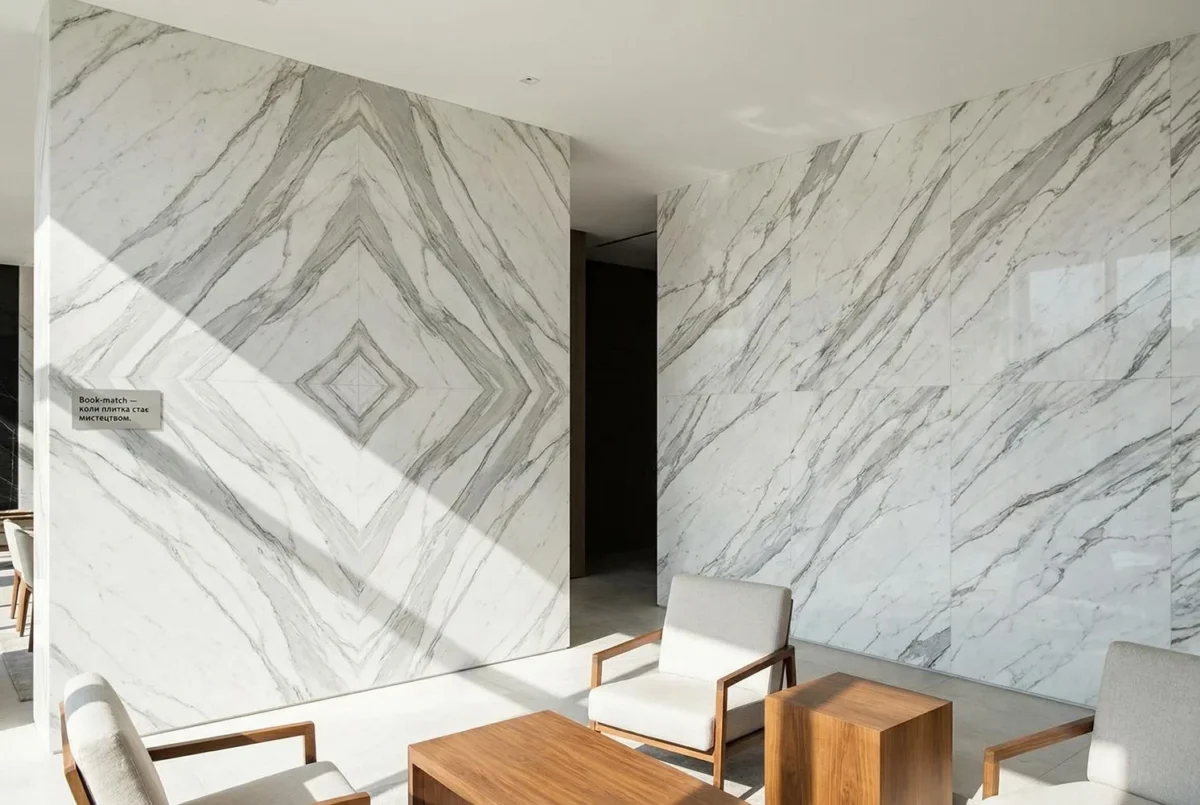
Book-match: when tile becomes art
Imagine an open book: the left and right pages are mirror images of each other. This very principle underlies the book-match technique, one of the most striking ways of laying large-format tile and natural stone. When two slabs with an identical pattern are laid as mirror images, they create a symmetrical composition that catches the eye and turns an ordinary wall into a work of art.
M-STONE specialises in book-match and vein-match laying of large-format tile and natural stone. Our craftsmen master the technique of creating symmetrical compositions, which takes not only professional skills but also an artistic vision.
What book-match and vein-match are
Book-match (mirror laying)
Definition: Book-match is a laying technique in which two neighbouring slabs are placed as mirror images about a shared edge, creating a symmetrical pattern like an open book.
The principle
- A slab of natural stone or a large-format porcelain stoneware slab is taken
- It is cut in half (or two consecutive slabs from the same batch are used)
- One half is flipped over (mirrored)
- The two halves are laid side by side
- The pattern of one slab continues on the other as a mirror image
The result: a symmetrical composition with a central axis of symmetry, where the veins of the stone create a harmonious pattern.
Vein-match (continuing the veins)
Definition: vein-match is a laying technique in which the veins of the stone continue from one slab to another without mirroring, creating the effect of a continuous natural surface.
The principle
- The slabs are cut one after another from a single large slab
- They are laid in the same order in which they were cut
- The veins of one slab flow smoothly into the veins of the next
- The effect of a solid stone surface is created
The result: a continuous pattern without symmetry, imitating a large slab of stone.
The difference between book-match and vein-match
| Characteristic | Book-match | Vein-match |
|---|---|---|
| Symmetry | Mirror symmetry | No symmetry |
| Pattern | Symmetrical (like a book) | Continuous (like a river) |
| Effect | Classic, formal | Natural, organic |
| Complexity | Higher | Medium |
Where book-match is used
Accent walls
Living room
- The wall behind the TV
- The fireplace area
- The central wall of a room
Bedroom
- The wall behind the headboard
- An accent wall opposite the window
Halls and hallways
- The wall opposite the entrance (the first impression)
- The mirror area
Bathrooms
The wall behind the bath: the classic use of book-match. A symmetrical composition creates a focal point in the bathroom.
The shower area: book-match on the shower cubicle wall is an elegant and practical solution.
The wall behind the washbasin: a symmetrical pattern around the mirror emphasises the central axis.
The kitchen
A kitchen island: book-match on the side surfaces of the island or on the countertop.
The backsplash: symmetrical laying of marble-look tile along the whole length of the backsplash.
Fireplace surrounds
Book-match on a fireplace facade is a classic of the genre. The symmetry emphasises the solemnity of this element.
Commercial premises
Hotel and office receptions: the wall behind the reception desk is an ideal place for a book-match composition.
Business centre lobbies: an entrance area with book-match laying demonstrates status and attention to detail.
Restaurants: an accent wall in the dining room to create an atmosphere of luxury.
Materials for book-match
Natural stone
An ideal material for book-match, because every slab is unique.
Marble
- Calacatta: the most popular choice, expressive veining
- Statuario: contrasting veining on a white background
- Arabescato: a complex pattern of veining
- Breccia: a fragmented structure
- Portoro: black with golden veining
Onyx
- Translucency adds depth
- With backlighting: a magical effect
- Unique patterns on every slab
Quartzite
- Patagonia: turquoise-blue with expressive veining
- Cristallo: translucent with crystals
- Taj Mahal: creamy with delicate veining
Large-format porcelain stoneware
Modern porcelain stoneware imitates natural stone with the possibility of book-match.
Advantages of porcelain stoneware for book-match
- Identical slabs (a predictable result)
- A lower cost compared with stone
- Larger formats (up to 160×320 cm)
- Easier processing and laying
Popular collections for book-match
- Calacatta imitation
- Statuario imitation
- Onyx imitation
- Collections with expressive veining
Important: book-match in porcelain stoneware needs special collections in which the manufacturer has provided mirror pairs of slabs. Not all marble-look tile is suitable for book-match!
Types of book-match compositions
Classic book-match (two slabs)
Description: two slabs are laid as mirror images about a vertical axis.
Application
- Small accent walls
- Backsplashes
- Fireplace surrounds
Four-way book-match (butterfly)
Description: four slabs are laid as mirror images in two planes, vertically and horizontally.
The effect: the pattern resembles butterfly wings or a kaleidoscope picture.
Application
- Large accent walls
- A living room floor
- Central elements
Diagonal book-match
Description: the slabs are laid as mirror images about a diagonal axis.
Application
- Non-standard design solutions
- Dynamic compositions
Continuous book-match
Description: several pairs of slabs are laid in sequence, creating a repeating symmetrical pattern over a large area.
Application
- Long corridors
- Large halls
- Building facades
Vein-cut book-match
Description: the stone is cut along the veins (vein-cut) and then laid book-match.
The effect: linear veining creates a symmetrical pattern resembling the heartwood of a tree.
Application
- Modern minimalist interiors
- Horizontal compositions
Technology of carrying out book-match
Stage 1: selecting the material
For natural stone
- A visit to the supplier’s warehouse
- Inspecting slabs from the required batch
- Selecting slabs with a matching pattern
- Checking the compatibility of the veining
- Marking the chosen slabs
Selection criteria
- Similarity of colour and shade
- Matching veining at the edge
- No defects in the junction zone
- Sufficient size for the project
For porcelain stoneware
- Choosing a collection with a book-match option
- Ordering mirror pairs
- Checking completeness on receipt
Stage 2: designing the layout
Tasks
- Determining the central axis of the composition
- Planning the position of the joints
- Calculating the necessary cuts
- Visualisation of the result
Tools
- Computer modelling
- Photos of the slabs for virtual laying
- A 3D visualisation for the client
Important to take into account
- The position of sockets and switches
- Junctions with other materials
- Symmetry relative to architectural elements
- The direction of the veining (horizontal or vertical)
Stage 3: cutting
For natural stone
- Marking the cutting lines on the slabs
- Numbering the fragments
- Cutting on a CNC machine or a large-format cutter
- Accuracy control
- Finishing the edges
For porcelain stoneware
- Fitting to the wall dimensions
- Cutting with a wet saw or on CNC
- Marking the face side
Precision is critical: an error of even 1-2 mm will be noticeable at the junction of mirrored slabs.
Stage 4: preparing the base
Requirements for the substrate
- Perfect flatness (differences of up to 1 mm over 2 m)
- Cleanliness and dryness
- Priming
- Marking the central axis and guides
Special attention: for book-match the base must be perfect, because any irregularity will break the symmetry.
Stage 5: laying
The sequence
1. Determining the central axis
- A laser level
- Marking on the wall/floor
- Checking vertical/horizontal
2. A trial layout (dry)
- Laying out the slabs without adhesive
- Checking that the pattern matches
- Adjusting if needed
3. Applying the adhesive
- Double application (to the base and the slab)
- An even layer
- Working in sections
4. Fitting the first slab
- Exact positioning relative to the axis
- Levelling
- Fixing
5. Fitting the mirror slab
- A minimal joint (1.5-2 mm)
- Exact alignment of the pattern
- A levelling system to level the plane
6. Checking
- Checking the symmetry
- Checking flatness
- Adjusting before the adhesive sets
Stage 6: grouting
Features
- Minimum joint width
- The grout colour is as close as possible to the tile background
- Or contrasting (a deliberate design accent)
- Epoxy grout for a perfect result
The central joint: the joint between the mirrored slabs is the most important. It must be perfectly straight and as inconspicuous as possible.
Difficulties of book-match and how to avoid them
Problem 1: pattern mismatch
Cause: slabs from different batches or different parts of a large slab.
The solution
- Personal selection of slabs at the warehouse
- Marking and control of the sequence
- Working from a single slab
Problem 2: errors when cutting
Cause: inaccurate cutting that shifts the pattern.
The solution
- Cutting on professional equipment
- Double-checking dimensions
- A reserve of material for redoing
Problem 3: an uneven base
Cause: differences in the base break the plane and the symmetry.
The solution
- Careful preparation of the base
- Checking with a laser level
- Levelling before laying
Problem 4: shifting during laying
Cause: the tile shifts before the adhesive sets.
The solution
- Using a levelling system
- Temporary fixing
- Checking the position until it hardens
Problem 5: a visible central joint
Cause: the joint between the mirrored slabs is too noticeable.
The solution
- Minimum joint width
- Grout matching the background
- Rectified tile
Why choose book-match
Aesthetic advantages
- A unique composition
- A luxury effect
- Harmony and symmetry
- A visual centre of the space
- A wow effect for guests
Practical advantages
- Visual enlargement of the space
- Hiding the joints (attention on the pattern)
- Increases the value of the property
- A timeless design
Examples of completed M-STONE projects
Project 1: a bathroom with Calacatta
The task: create a luxurious bathroom with an emphasis on the wall behind the bath.
The solution: book-match in large-format Calacatta-look porcelain stoneware (120×260 cm slabs).
The result: symmetrical veining created the effect of a luxurious marble panel.
Project 2: a business centre reception
The task: impress visitors from the first seconds.
The solution: four-way book-match in natural onyx with LED backlighting.
The result: a wall glowing from within became the business centre’s calling card.
Project 3: a fireplace surround in a private house
The task: create a grand fireplace in a classic style.
The solution: book-match in white Statuario marble.
The result: the fireplace became the central element of the living room.
Contact information
M-STONE: experts in book-match laying
📞 Phones: +38 068 100 27 96, +38 050 914 18 99 📧 Email: [email protected] 🌐 Website: https://mstone.ua/
Social media
- Instagram: https://www.instagram.com/mstone_kiev/
- Facebook: https://www.facebook.com/mstone.kyiv/
- YouTube: https://www.youtube.com/@M-Stone_Kyiv/
Geography of work
Kyiv: all districts of the city Kyiv region: Brovary, Irpin, Bucha, Vyshhorod, Vyshneve, Boyarka, Kozyn, Koncha-Zaspa All of Ukraine: visits for exclusive projects across the country
M-STONE advantages for book-match
✅ Book-match laying experience: dozens of completed projects ✅ Work with natural stone: selecting slabs at suppliers’ warehouses ✅ Large-format porcelain stoneware: slabs up to 160×320 cm ✅ Our own production: precise cutting on CNC machines ✅ 3D visualisation: you will see the result before work begins ✅ An artistic vision: not just laying but creating a composition ✅ A quality guarantee: on all work carried out
The current cost of work for your project can be calculated in the online calculators or confirmed by the manager: it depends on the material, the slab format and the condition of the substrate. The consultation is free.

About M-STONE
This material was prepared by the M-STONE team: 20 years of brand history, installation of large-format tile and natural stone in Kyiv and across Ukraine. The company is led by Oleg Dolynskyi. The recommendations describe the typical order of work; a specialist refines the solution for your project after a consultation.
Contact us
We will price your project
Send the dimensions and slab format: we will calculate the material and installation and suggest the timing.