Travertine in Interiors and Exteriors: Installation, Care and Uses
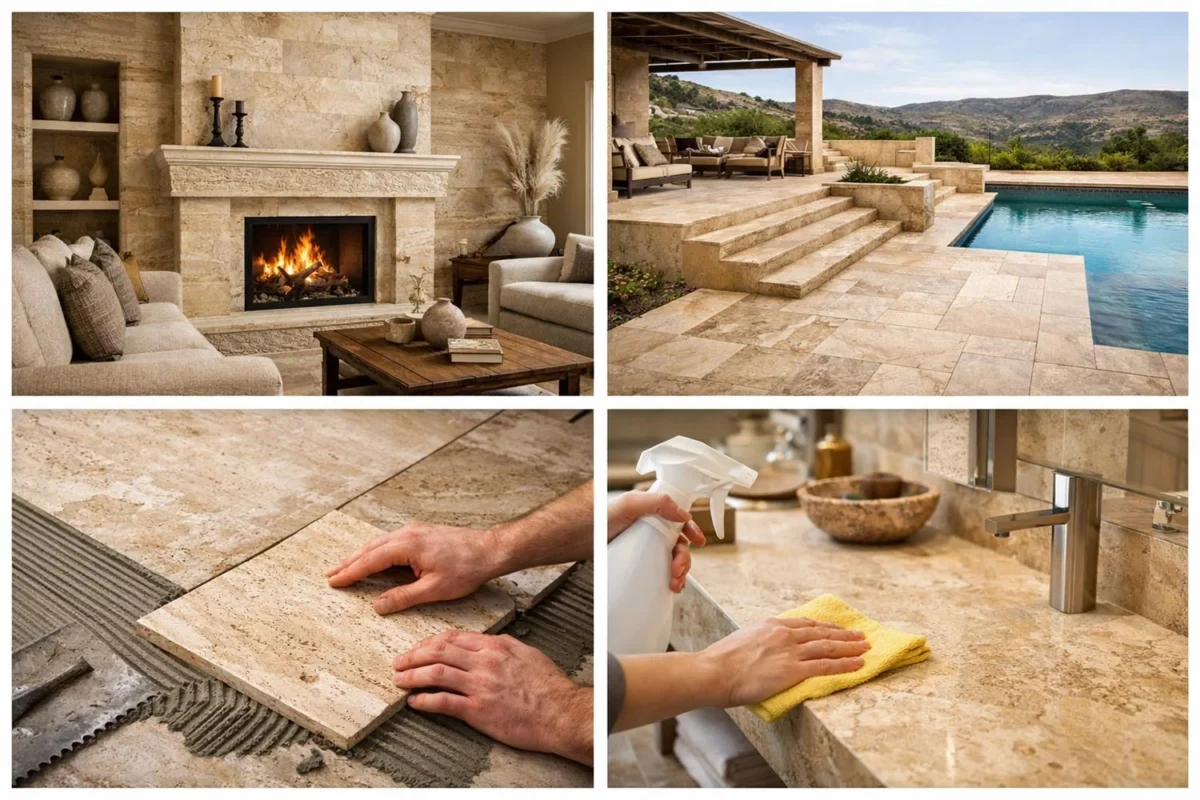
Travertine: a stone with a history of millennia
Travertine is a unique natural stone that humankind has used for more than 2000 years. The most famous structures of ancient Rome, including the legendary Colosseum, were built of travertine. This stone combines noble aesthetics, practicality and a special energy that only a natural material can give.
M-STONE is an expert in installing travertine in Kyiv and Ukraine. Our craftsmen know all the subtleties of working with this demanding material, ensuring flawless laying quality and the durability of the surface.
What travertine is: geology and origin
Travertine is a sedimentary rock, a variety of limestone formed by the deposition of calcium carbonate from hot mineral springs. The formation of travertine takes thousands of years, during which the stone acquires its characteristic porous structure and unique colouring.
Main travertine deposits
Italy (Tivoli) is the homeland of the most famous travertine in the world. Italian Romano Classic travertine is considered the benchmark of quality and beauty.
Turkey (Denizli) is the largest modern producer of travertine. Turkish stone is notable for its variety of shades and affordable price.
Iran supplies premium-quality travertine with unique patterns and rich colours.
Peru: an exotic travertine with unusual colour variations.
Mexico: a stone of warm golden and brown shades.
The travertine colour palette
The natural colour range of travertine includes:
Ivory: the lightest variety, a delicate cream shade. Ideal for classic interiors and for visually enlarging a space.
Classic: beige with characteristic brown veins. A universal option for any room.
Noce (walnut): a rich brown colour. Creates a feeling of warmth and cosiness.
Gold: a warm golden shade with honey notes. Adds sunniness to a room.
Silver: a greyish shade with a cool undertone. A modern choice for minimalist interiors.
Red: a rare variety with terracotta and reddish shades.
A polished surface (Lucido)
Polishing gives travertine a mirror shine and emphasises the natural pattern of the stone. The pores are filled with a special mastic in the tone of the stone.
Advantages
- A striking appearance
- Ease of care
- Emphasising the natural pattern
Disadvantages
- A slippery surface when wet
- Visibility of scratches
- Not recommended for bathroom floors
Use: walls, countertops, window sills, decorative elements
A honed surface (Levigato)
Honing creates a smooth matt surface without a bright shine. The pores can be filled or left open.
Advantages
- Moderate slip resistance
- An elegant restrained look
- Scratches are less visible
Use: floors in living spaces, walls, stairs
An antiqued surface (Anticato/Tumbled)
Artificial ageing of the stone by mechanical processing in special drums. It creates the effect of ancient stone with soft edges and an expressive texture.
Advantages
- An authentic antique look
- High slip resistance
- Hides minor damage
Use: floors, terraces, pools, exteriors
A brushed surface (Spazzolato)
Processing with metal brushes emphasises the natural texture of the stone, making the pores more expressive.
Advantages
- An expressive natural texture
- Good slip resistance
- A unique tactile effect
Use: floors, walls, exteriors
A sawn surface (Segato)
The surface after sawing the block, without additional processing. It has characteristic saw marks and a natural roughness.
Advantages
- The most natural look
- High slip resistance
- A budget option
Use: facades, retaining walls, landscape design
Standard formats
- 30.5×30.5 cm: a classic square
- 40×40 cm: a medium square
- 60×60 cm: a large square
- 30.5×61 cm: a rectangle
- 40×60 cm: a rectangle
- 60×90 cm: a large rectangle
Large formats
- 60×120 cm
- 80×80 cm
- 90×90 cm
- 120×120 cm
Slabs (large-format panels)
- Sizes up to 200×300 cm
- Thickness 20-30 mm
- For exclusive projects
Mosaic
- 2.5×2.5 cm
- 5×5 cm
- 10×10 cm
- On a mesh for ease of installation
Modular sets (French Pattern / Opus)
A set of slabs of different sizes for laying in a special pattern:
- A large square
- A small square
- A large rectangle
- A small rectangle
Modular laying creates a dynamic pattern and is the calling card of travertine floors.
Use of travertine in interiors
Floors
Travertine is an ideal material for floors in living spaces:
Living rooms and lobbies. A travertine floor creates an atmosphere of luxury and hospitality. The warm natural shades of the stone harmonise with any interior style, from classic to modern minimalism.
Bedrooms. Travertine is a warm stone that is pleasant to walk on barefoot. Combined with an underfloor heating system it provides maximum comfort.
Corridors and hallways. Travertine’s high wear resistance makes it a practical choice for zones with intensive traffic.
Kitchens. With correct processing and protection travertine is used successfully in a kitchen, adding elegance.
Walls
Cladding walls with travertine creates a unique atmosphere:
Accent walls in living rooms. A travertine wall becomes the central element of the interior, drawing attention and creating a sense of depth.
Fireplace areas. Travertine combines beautifully with fire, emphasising the cosiness of the family hearth.
Niches and columns. Decorative elements of travertine add architectural expressiveness to an interior.
TV areas. A travertine panel behind the TV creates a striking backdrop and softens glare.
Bathrooms
Travertine in a bathroom is a combination of natural beauty and functionality:
Important! For use in damp rooms travertine must be treated with a water repellent, a special impregnating product that protects the stone from moisture penetration.
Floors. Antiqued or brushed travertine ensures safety thanks to its anti-slip properties.
Walls. Travertine walls turn a bathroom into a real spa.
Shower cubicles. Travertine withstands constant exposure to water, provided it is processed correctly.
Countertops under a washbasin. Travertine countertops add individuality to a bathroom.
Fireplace surrounds
Travertine is a classic material for finishing fireplaces:
- Resistance to high temperatures
- Warm shades that harmonise with fire
- The possibility of creating complex architectural forms
- Durability and an unchanging look
Stairs and balustrades
Travertine stairs are a sign of refined taste:
- Steps with a rounded edge (bullnose)
- Risers with a contrasting pattern
- Balustrades and handrails of travertine
- Combination with wrought-iron elements
Countertops and window sills
Travertine is widely used for making:
- Kitchen countertops (with a protective coating)
- Bathroom countertops
- Window sills
- Countertops for furniture
- Bar counters
Building facades
Facade cladding with travertine:
Ventilated facades. Travertine slabs are mounted on a metal frame with a ventilation gap, which ensures thermal insulation and durability.
Wet facades. The slabs are bonded directly onto the insulation. An economical option for low-rise construction.
Advantages of travertine facades
- Natural beauty and prestige
- Resistance to weather
- Thermal insulation properties
- Durability (hundreds of years)
- Eco-friendliness
Terraces and open areas
Travertine is ideal for terraces:
- Does not heat up in the sun (unlike dark materials)
- Pleasant to walk on barefoot
- Anti-slip properties (antiqued finish)
- Frost resistance (with correct installation)
- Natural beauty combined with the landscape
Pools and spa areas
Travertine is a favourite material for building pools:
Pool copings. Special profiled elements ensure safety and comfort.
The floor around the pool. Antiqued travertine prevents slipping on a wet surface.
Walls. Travertine walls create the atmosphere of Roman baths.
Entry steps. Steps with anti-slip grooves.
Garden and park decoration
Travertine fits organically into landscape design:
- Garden paths
- Retaining walls
- Fountains and waterfalls
- Gazebos and pergolas
- Garden furniture (benches, tables)
- Sculptural elements
Fences and enclosures
Travertine fences are a sign of status and taste:
- Posts and pylons
- Filling the spans
- The plinth
- Combination with wrought-iron elements
Substrate preparation
Requirements for the substrate
- Flatness (differences of no more than 3 mm per 2 m)
- Strength (at least M150)
- Dryness (moisture no more than 4%)
- Cleanliness (no dust, oils or old coverings)
Preparation work
- Dismantling old coverings
- Repairing cracks and potholes
- Making a screed if needed
- Waterproofing (for bathrooms, pools)
- Priming
Choosing the adhesive mix
For travertine special adhesive mixes are used:
White adhesive is mandatory for light travertine. Grey adhesive can show through the porous structure of the stone and change its colour.
Flexible adhesive is for underfloor heating, large formats and wooden substrates.
Fast-setting adhesive is for when commissioning needs to be sped up.
The laying process
A trial layout. Before laying, the slabs are arranged without adhesive to choose the pattern and determine the best placement.
Applying the adhesive. The adhesive is applied to the substrate and to the tile (double application) to ensure 100% contact.
Laying the slab. The slab is laid with light pressure and position adjustment.
Levelling. The flatness of the surface is ensured with a levelling system and a level.
Grouting the joints. After the adhesive dries the joints are filled with grout in the tone of the stone.
Final treatment
A water-repellent treatment. Treating travertine with a water repellent is mandatory. The impregnation penetrates the pores of the stone and protects it from moisture and stains.
Polishing (optional). Additional polishing can improve the look of the surface.
Crystallisation (for polished surfaces). A chemical treatment that increases the gloss and hardness of the surface.
Daily care
- Removing dust with a dry soft cloth or a vacuum cleaner
- Washing with neutral cleaning products
- Immediately removing spilled liquids
Periodic care
- Deep cleaning with special stone products
- Renewing the water-repellent treatment (once every 1-3 years)
- Polishing (if needed)
What not to do
- Use acidic products (vinegar, lemon juice)
- Use abrasive sponges
- Allow long contact with coloured liquids
- Use universal household cleaning products
What the cost of installing travertine in Kyiv depends on
- The type and size of the tile
- The method of laying (straight, diagonal, modular)
- The condition of the substrate
- The need for preparatory work
- The complexity of the site
- The volume of the order
Contact M-STONE to calculate the cost of your project!
Contact information
M-STONE: professional travertine installation in Kyiv and Ukraine
📞 Phones: +38 068 100 27 96, +38 050 914 18 99 📧 Email: [email protected] 🌐 Website: https://mstone.ua/
We are on social media
- Instagram: https://www.instagram.com/mstone_kiev/
- Facebook: https://www.facebook.com/mstone.kyiv/
- YouTube: https://www.youtube.com/@M-Stone_Kyiv/
Service areas in Kyiv
We work in all districts of Kyiv and the suburbs:
Kyiv: Pechersk, Lypky, Podil, Obolon, Pozniaky, Osokorky, Darnytsia, Troieshchyna, Vynohradar, Sviatoshyn, Borshchahivka, Holosiiv, Teremky
Kyiv region: Brovary, Irpin, Bucha, Vyshhorod, Vyshneve, Boiarka, Ukrainka, Obukhiv, Kozyn, Koncha-Zaspa, Vorzel, Hostomel
Advantages of working with M-STONE
✅ A specialisation in natural stone: travertine, marble and onyx are our core competence
✅ Our own materials warehouse: we will help with choosing and buying travertine
✅ Professional equipment: tools for quality stone processing
✅ Experienced stonemasons: craftsmen with many years of experience with travertine
✅ A full cycle of services: from consultation to final treatment
✅ Guarantee: we provide a guarantee on all work performed
The current cost of work for your project can be calculated in the online calculators or confirmed by the manager: it depends on the material, the slab format and the condition of the substrate. The consultation is free.

About M-STONE
This material was prepared by the M-STONE team: 20 years of brand history, installation of large-format tile and natural stone in Kyiv and across Ukraine. The company is led by Oleg Dolynskyi. The recommendations describe the typical order of work; a specialist refines the solution for your project after a consultation.
Contact us
We will price your project
Send the dimensions and slab format: we will calculate the material and installation and suggest the timing.