The Chemistry and Physics of a Flawless Floor: A Deep Look at Adhesion and Deformation When Working with 3000×1500 mm Slabs
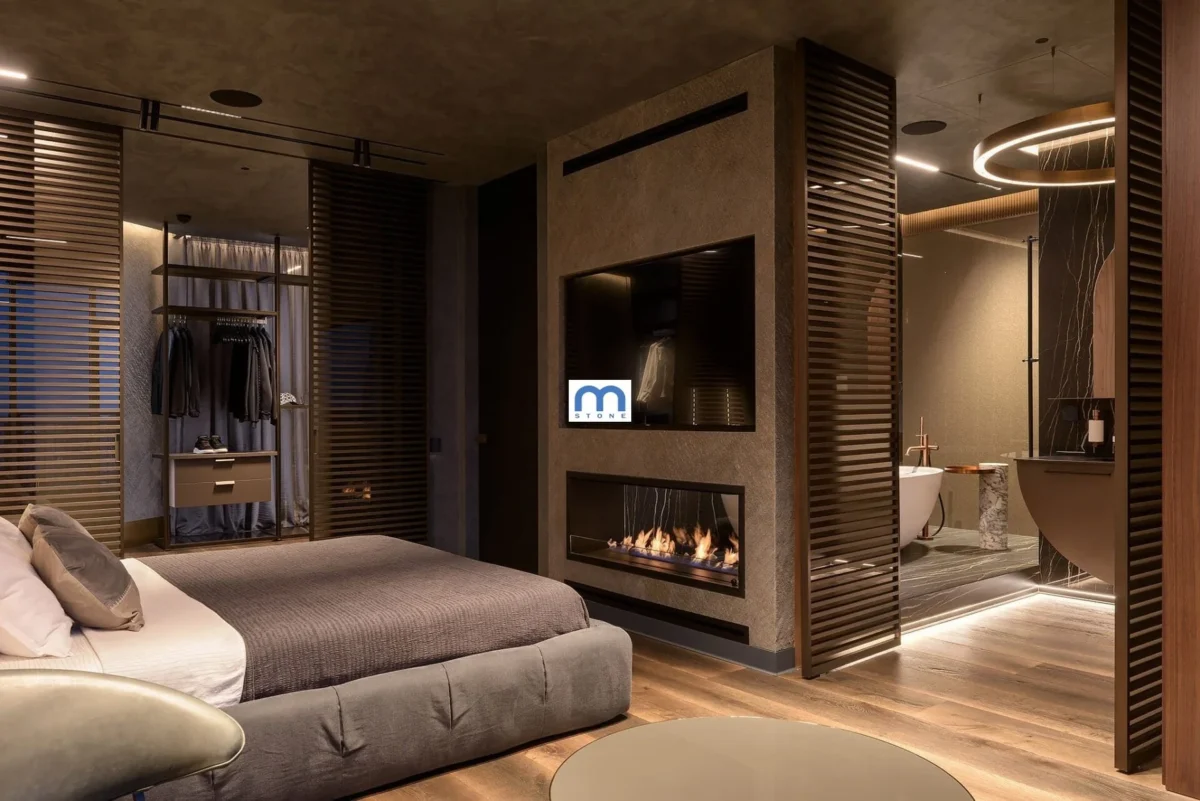
In modern interior design in Kyiv, especially in landmark projects such as the Taryan Towers, Novopecherski Lypky or Bulvar Fontaniv residential complexes, large-format porcelain stoneware has become the only standard. However, when we talk about slabs of 3000×1500 mm or 3200×1600 mm, the physics of the installation process changes radically. The specialists of m-STONE have prepared a detailed analysis of why ordinary methods do not work here and how to avoid catastrophic mistakes.
- The problem of the “living” building and thermal expansion
Any building in Kyiv, whether a historic house in Podil or a new skyscraper in Pechersk, is subject to micro-movements. Porcelain stoneware is a rigid material, while concrete is porous and prone to shrinkage. With a slab area of more than 3-4 m2, internal stresses can reach critical levels.
If a rigid adhesive is used, then at the slightest shrinkage or when an “underfloor heating” system is switched on, the slab will either crack or come loose (“swell”). That is why M-STONE uses only highly deformable adhesives of CLASSES C2 S1 and C2 S2 (according to the European standard EN 12004). An S2 adhesive can deform by more than 5 mm without losing adhesion, working as a shock-absorbing cushion between the building and your finish.
- Substrate preparation: the CM measurement method and flatness
We often come across developers in Kyiv handing over sites with a “flat” screed. For large format, “flat” means a deviation of no more than 1 mm per 2 linear metres. Any sagging of the substrate creates a void under the slab, which will cause a crack if you simply step on it in heels.
Moisture control: we do not start installation until the screed moisture drops below 2%. We use the carbide hygrometer (CM) method, because ordinary electronic sensors are often wrong. This is critical: moisture trapped under a huge slab will destroy the adhesive layer within half a year.
Mechanical cleaning: the substrate is ground with diamond cups to remove the “cement laitance” and open the pores of the concrete, and is then dedusted with Festool industrial vacuum cleaners.
- Full-coverage technology and vibration compaction
The main enemy of a slab is air. Even a bubble the size of a coin can become a stress concentration point.
Double application: adhesive is applied to the wall/floor and to the back of the slab. Important: the trowel ridges must run strictly parallel to each other and to the short side of the slab. This lets the air escape freely when the slab is positioned.
Vibration laying: we use cordless vibrating suction cups. The vibration “settles” the heavy slab, making the adhesive ridges collapse into a single monolithic layer. This is the only way to achieve 100% contact area.
M-STONE works in all districts of Kyiv: from Solomianka to Obolon, including the cottage communities in Kozyn and Vyshenky. We guarantee that your floor will not crack either after a year or after ten years.
Entrust the installation to experts who know the physics of stone!

About M-STONE
This material was prepared by the M-STONE team: 20 years of brand history, installation of large-format tile and natural stone in Kyiv and across Ukraine. The company is led by Oleg Dolynskyi. The recommendations describe the typical order of work; a specialist refines the solution for your project after a consultation.
Contact us
We will price your project
Send the dimensions and slab format: we will calculate the material and installation and suggest the timing.