Preparing the Substrate for Large-Format Tile: Myths and Reality
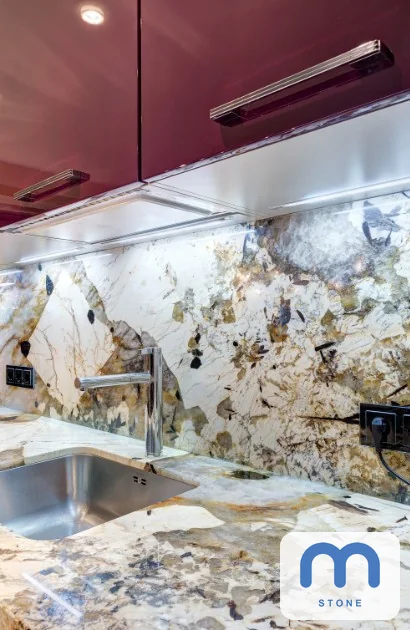
The most frequent and most critical mistake in a renovation is an attempt to save on or simplify the substrate preparation stage. If some compromises are acceptable for small-format tile, then for tile of 120×240 cm, 160×320 cm or even 60×120 cm the substrate must be absolutely perfect. It determines whether your expensive surface will last for decades flawlessly or crack, creak or peel off after just a year. At M-STONE in Kyiv we believe that correct preparation is 90% of a successful large-format installation, which is why we use only the strictest standards.
Criteria of a perfect substrate for large format:
Flatness. This is the most important parameter. The permissible deviation is no more than 2 mm per 2 metres of length (according to the European standard DIN 18202 and building codes). It is desirable to aim for 1-1.5 mm. It is checked with a long metal straightedge (2-2.5 m) or a laser level. Every pit or bump is a point of stress concentration. Under load the tile will “play” like a trampoline and in time will certainly crack at its weakest point, often right in the middle of the tile.
Strength and load-bearing capacity. The substrate must not crumble, produce dust or sag. The minimum permissible compressive strength is 20 MPa (cement grade M200 and above). How do we check at M-STONE? With a simple blow of a hammer or a metal roller. If the surface does not withstand it, it needs strengthening or complete dismantling. An old loose screed, loose tile or crumbly plaster is unacceptable.
No dust, contamination or delamination. The surface must be clean, degreased and free of paint, remains of old adhesive, oil and bitumen. We use industrial vacuum cleaners and always carry out deep priming to bind dust and improve adhesion.
Normal moisture. The maximum permissible moisture of a concrete substrate is 2-3%, of an anhydrite one 0.5%, of a gypsum one 0.5%. Laying on a damp screed is the most common hidden cause of future problems. Moisture, looking for a way out, will rise through the capillaries, weaken the adhesive layer or provoke mould under the tile. On sites in the districts of Kyiv closer to water (Osokorky, Trukhaniv Island) we are especially careful about measuring moisture.
No expansion joints in the “body” of the surface. It is important to treat and replicate the building’s expansion joints correctly. A tile that bridges such a joint will certainly tear. Calculating and building technological joints in a tile surface is a mandatory stage of our craftsmen’s work.
The preparation stages we apply at M-STONE for sites in Kyiv and the region:
Dismantling the old covering down to a strong, solid substrate. We do not leave old tile, laminate on adhesive or a wooden floor.
Deep-penetration priming in 2-3 coats to bind dust, strengthen the surface layer and improve adhesion with the new screed.
Levelling to beacons or pouring a self-levelling mortar. The choice of method depends on the level of the differences:
For differences of more than 3-5 cm: a cement-sand screed to beacons with reinforcing mesh. We use modified mixes with plasticisers.
For differences of up to 3 cm: high-strength self-levelling floors. This is our speciality for getting a perfect plane under large format. We work with mixes that give strength of more than 25 MPa.
Mandatory grinding of the set screed with special machines to remove small defects and beacons and to improve adhesion.
Final control with a laser level. Without a signed inspection record, preparation work is not considered finished.
Debunking dangerous myths about preparation:
“A strong adhesive will level out small unevenness.” A fatal mistake! Adhesive for large tile is applied with a notched trowel with a 10-12 mm comb. Its thickness when compressed after laying is 3-5 mm. It physically cannot act as a leveller. Its job is to ensure full contact and adhesion, not to eliminate bumps and pits.
“You can lay on old tile to save on dismantling and screed.” You cannot. It lowers the height of the room and, above all, it is impossible to guarantee the bond strength of the “tile-to-tile” adhesive. The risk that the whole “pie” peels off the main slab under load increases many times over. There is no guarantee for such work.
“A thick underlay film or a cork underlay is enough.” These materials perform the functions of water- or sound-proofing. They do not compensate in any way for unevenness of the substrate. Laying large format on a soft, springy underlay will lead to failure.
Understand that the cost of materials and substrate preparation work can reach 30-50% of the total estimate for installing porcelain stoneware. But it is not an expense, it is your insurance. It is an investment in making sure your expensive square metres of porcelain stoneware last forever.
M-STONE in Kyiv offers a full turnkey package of work. We take responsibility for the whole chain: from dismantling and creating a perfect substrate to the final grouting of the joints and final cleaning. By ordering everything from one company you get:
A single guarantee for the whole work (including the substrate!).
Clear responsibility.
A much faster process because all the stages are coordinated.
Do not save on the foundation of your interior! Order professional substrate preparation from M-STONE.
Phones: +38 068 100 27 96, +38 050 914 18 99
Email: [email protected]
Follow our work: Instagram (@mstone_kiev), Facebook (mstone.kyiv), YouTube (@M-Stone_Kyiv).
The current cost of work for your project can be calculated in the online calculators or confirmed by the manager: it depends on the material, the slab format and the condition of the substrate. The consultation is free.

About M-STONE
This material was prepared by the M-STONE team: 20 years of brand history, installation of large-format tile and natural stone in Kyiv and across Ukraine. The company is led by Oleg Dolynskyi. The recommendations describe the typical order of work; a specialist refines the solution for your project after a consultation.
Contact us
We will price your project
Send the dimensions and slab format: we will calculate the material and installation and suggest the timing.